Saturday, December 26, 2009

c.010101 EOY Round-up Home for the Holidays


Mamma told me there’d be days like these.

In the year that the term defriend became the lingua franca de annum in a publication as august as the New Oxford English Dictionary, we’re certainly witnessing the dawn of the social networking era and its inevitable hyper-self-absorption as witnessed in this subsequent navel-gazing debate over whether the announcement actually meant to say “unfriend.” Unfriend/Defriend? Am I unconcerned or deconcerned? Ask me next year.

When I started cleaning my email e-Holiday card list I went first to my own modest social network on Facebook, then took a dive into LinkedIn and even Skype and Plaxo for hard to find colleagues who’ve changed addresses, jobs or locations. The social networks have proven remarkably agile at this task and I suspect will become moreso as their ubiquity increases. Gone are the days when you had to endure pop-up, spyware crap laden “Look-up applications” in order to update an email ad' or a phone number. The S-Net represents the first, albeit baby step toward each one of us being able to manage our own presence and information profile effectively and for this they are important and good. My first pass was able to garner me a brand new line on a friend I hadn’t seen in 32 years and current emails for 30 job-hoppers who hadn’t remembered to send me “I’ve moved” notices.

Once I nailed that problem down, (about two days over a 1900 entry address list), I tackled a hair-puller that has plagued me for four years. This one involved how Outlook sends graphic files. I created my nice little e-card ...


 ... but repeated sends revealed that somehow Outlook was mashing it up and sending this


Ugh!!!

My seasonal nightmare four years running. Tried saving in all formats and all resolutions. Always the SOS.  I could find nothing in the online literature that suggested why this was so, but a combination of research and trial and error and dumb ### luck finally yielded a way to insert a modestly attractive gif file into the Outlook message envelope and not have it look like hash after it’s sent. For those of you on my e-card list. This is why you got it today, rather than a week ago. For those of you who employ high power graphics programs and remailers or software designed to block such email, you don’t care, so read on. Anybody interested in how I did it can contact me. I’ll spill all for the benefit of science.

InterFACEbook
My 15 year old asked today whether it was random chance that Facebook made it so big rather than MySpace or other social sites and I asked him why he thought it was so. He thought for a moment then said perhaps it was “the menu and stuff” which I took to mean “interface” and we had a “teachable moment” about interface design and its importance to personal information management. His is the interface generation. They juggle icons and menus like my generation manipulates words and phrases. We talk about how much catching up they have to do to bring depth and nuance to their conversations but our generation has just as much catching up to bring conversation to our depth and nuance.

Nobody has really monetized social network applications yet, but I have a feeling that the social networks have created the next great wave in personal computing and that we’re just on the lift of the swell of the Web 3.0, the “you web” where you can do everything from start a revolution to learn what your f&f had for dinner.
The social networks bring another small but not so minor innovation to the desktop, particularly if you use Outlook, like much of corporate America. Using a plug-in named Xobni, (“zobni”) it interfaces with your social network and if the api stars align, you get a little thumbnails for your contacts.


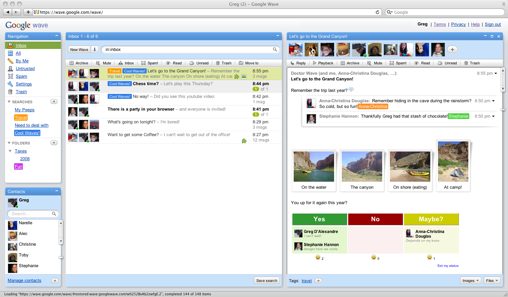
Google Wave promises to slam all that together under the ubiquitous Google umbrella as the next big e-thing and while the big G offers users tremendous utility for the show-stopping price of “free” you have to worry about how much of your life you’re willing to entrust to the G cloud, from search history, to documents, to emails to social networks, before they “own” you. This from the company that was so willing to support the Great Firewall of China. They don’t exactly call to mind the hard-bitten media moguls of the 20th Century who stood on free speech as if it were inviolable and sent grizzled reporters and publishers to prison singing Cumbayah before they’d allow a government entity to dictate to them. I don't know how good I feel about putting all my eggs in a cloud. Strange days indeed.

There are sources of stuff “they don’t want you to know about” But you have to go looking. My top 5 choices for stories to follow in 2010 are:
1.      Do you really think the Obama administration will have the balls to go after financial reform when the Treasury Department is just another revolving door for Wall Streeters?
2.      Who the ### is Joe Lieberman to take the public option off the table and why the Dems are allowing the Senator from The Insurance State to steal true healthcare reform from us?
3.      Verizon promised me fiber to the curb in 1996. Who do I have to #### to get my FIOS in 2010?

4.      Save a tree and save our children’s’ spines. When will Amazon wake up and put a Kindle in every student’s backpack? 
5.      The strange particles that bombard us when politics and science collide over global warming. Will we get the real story before they ship us all off to Mars?

These are my hot buttons. You have the right to your own damned buttons but things like these really @!$$ me off and when they’re deliberately under-reported that really @!$$es me off even more. Stories like these are not right at your fingertips. You have to stretch a little. Stretching is good. Testing your calcium against diverse beliefs (as in a couple of above links) is good for the ethical bone structure and results in shining white teeth.

Make 2010 the You Web Year. Make the “You Web” yours and put it/yourself out there for the world to see. You even have the right to go through other people’s stuff (within limits they’ve established.) Most recently, you now have the right to aggregate and interface to satisfy your own peculiarities and curiosities. Poke it, prod it. Ride it for all its worth. It’s never been easier, more fun or more popular.

Just remember the words of Horace, the Roman poet who urged us and all schoolboys to “carpe diem” also warned “Semel emissum volat irrevocabile verbum.”

Once released, the word flies (or in this case drops) irrevocably.
To all Friends and Family on more than one continent who care enough to keep coming back to read, mille mille grazia.

To all …
Happy END OF 2009 with BIG HOPES for Happier 2010!

Friday, October 9, 2009

The Curse of Dr. Barnes

Before


After

The Barnes Foundation, according to its own website "is home to one of the world's largest collections of Impressionist, Post-Impressionist and early Modern paintings, with extensive holdings by Picasso, Matisse, Cézanne, Renoir and Modigliani, as well as important examples of African sculpture."

The design for the new home of the worldclass impressionist collection amassed by the uber-contentious Dr. Al Barnes bears an eerie and unwelcome resemblance to the Juvenile Detention Center which it replaces.

A Bit of Barnesian Background
The Barnes Collection has one of the most embattled legacies in the history of American art collection, even inspiring a movie with the overwrought title “The Art of the Steal."  The good doctor who died in 1951, made a fortune in nostrums and patent medicines. He also had a true talent for shopping in Europe and managed to scoop up a lot of "bargain basement" art at firesale prices.  I haven't seen "The Art of the Steal." I wonder if it even touches on how this shiny collector and creator of Argyrol, nickled the starving artists whose works he bought for a song. But that's art in the age of commerce for you--a sad tale, but scarcely worth a historical footnote.

What makes the infamous Barnes backstory fascinating is that Doc B had no great love of the city and its business and cultural leaders. Seems they turned up their narrow blue noses at his self-made, new money social ascendancy, so he got his payback. Using his collection as a sort of cultural hostage, he forged a will he clearly intended to be unbreakable. Then he used it as a hammer to hit the art establishment over the head with, long after he was gone. Basically, the will said that The Collection could never:
  • Be broken up
  • Exhibited/toured
  • Or worse, moved!
Call it karma, but Barnes died of a tragic auto accident, his legacy still very much in flux. One wonders if he was a victim of self-inflicted road rage. While other private art foundations manage quite well, the Barnes made the news with its odd choice of stewardship and its court battles. Today, Dr. B may be heartened that his unquiet spirit transmigrated to cohabit with certain quixotic forces who still battle to prevent the collection's move.

Maybe a hundred years hence, the Barnesiacs and the township of Merion will band together and take a page from the Egyptians who after decades of righteous contention, were able to repatriate their priceless antiquities from the Louvre.  The fact is that languishing out in leafy Merion, PA, mired in restrictive visitation policies, the prickly half-love of its neighbors and the bizarre internecine politics of its dysfunctional board, the Foundation and its Collection was drowning in red ink. The Pew and the Lenfest Foundations stepped in and threw Barnes a lifeline, but the bailout inked a devil's deal. It required the collection to move to the city where it can finally be appreciated by Philadelphia residents and visitors without special papal dispensation.

This battle waged famously for years in Philadelphia Orphan's Court. Recently Barnes' grudge-drenched will was broken in a gust of sulfur and smoke and what I'm sure are several legal precedents. Philadelphia Lawyers may moan, but art lovers of all stripes are the beneficiaries. Albert Barnes' vitriol was ultimately his foundation's aqua regia.  The experience of the Barnes an object lesson in how even great philanthropy can run aground when a benefactor's nits and gripes overshadow a more expansive, enduring vision of contribution to society. Anger, art and philanthropy make for a gritty salad.

I'm just a little guy with a big mouth and I doubt I'll ever be able to put the following principle to the test. But I believe that if you have the resources to acquire great art, it comes with an implicit noblesse oblige to share your spoils with society. What Barnes did was like commissioning a Mozart symphony, then restricting its performance to his basement. Great art demands the greatest possible audience--access by ordinary people who would be its patrons. Not an elite few. However much money and power you have, you can't narrowcast a cultural legacy in perpetuity. That's the nutshell. Now back to the future.

The House that Barnes Didn't Build

Call it "the takeover of the imperial art establishment" or just call it inevitable triumph of good sense; it seems in any case to be a done deal, a baked cookie. What feels half-baked, is the design by Todd Williams and Billie Tsien. Look at their spectacular design for the Phoenix Art Museum then come back and compare. Though in an Inquirer online reader feedback poll people seem to prefer the new design by a large margin, I ask:

'Where is the visual drama worthy of the collection?'

Why must so much Philadelphia architecture be confined to pedestrian brick and stone? Why don't the commissions who rubber stamp blandchitecture like this have the cojones to point the fancy out-of-town architects back to their drawing boards with the stern admonition to really "bring it" next time. Don't the architects who design for this city have more contemporary and uplifting materials in their palettes?  In the case of Williams and Tsien, they do, they just ain't sharin' it with Philly. Everywhere I go in Philly, I see new buildings going up that look like more of the same. They think they're reflecting the spirit of the city, when in my humble, each new uninspired brick and stonefaced edifice reinforces an anti-progressive, provincial frumpiness this city is trying so hard to shake off.

It's not that I'm looking for wild radicalism like Frank Gehry's scary metal monster in Bilbao, though love it, hate it, or think it resembles a Transformer, at least it makes a impression. Inga Saffron, whose every opinion I normally dote on like a starry-eyed fanboy, praised the punched windows resembling those in the facade of the Barnes' neoclassical home in Merion.


Yawn. So what? A handful of punched windows aren't going to mollify the Barnesiacs who'd rather see their precious collection shuttered than exhibited the way worldclass art should be.

What is the virtue of such nostalgic tribute when weighed in the balance with an opportunity to create a bold, visual exclamation point to Philadelphia's aspirations to evolve as a center of art and culture?  We deserve better.

Don't get me wrong, I am gladdened that this historic collection is finally about to be wrested out of its snuggery in the Land of Lockjaw, but it should come downtown and present its face to the Parkway. It should announce itself with drama and pride, not landscaping.

I walk The Parkway nearly every day. This corridor, one of my favorites in a gloriously walkable city, has so much potential. Yet I fear it will never be as grand as it could be, especially if one of its anchor tenants turns its face away.

"It is an absolutely masterful design. Those who don't understand the design are looking at it from a selfish point of view," according to Moe Brooker of the Philadelphia Art Commission.
I'm just a selfish guy. Well harumph!

Am I missing something?
I think not.
I think the old curmudgeon has spun twice and is now cackling in his grave.
Maybe there's another movie in it
Call it, "The Revenge of Dr. Barnes."
Too bad Vincent Price isn't around to play the lead.

Thursday, September 17, 2009

Losing My Identity

Two weeks ago I lost my wallet.

I'd checked everywhere, through six pairs of pants, through three closets, under my bed, in all my drawers and every room of the house. I retraced my steps and when it didn't net any results, I redoubled my efforts. Beyond humiliation, I asked friends whose houses I'd visited to check their bathrooms.

The first piece of advice friends and family gave me was to cancel my cards. I picked up the phone and actually dialed my bank. Three minutes  through the annoyance of the bank's voice-automated system, I let the angels of optimism and hope triumph over the angels of caution and financial prudence. I hung up, but I'm not stupid. For the next 15 days I monitored my bank balances on a twice daily basis. I drilled my wife on any item I did not immediately recognize as a regular expense. Day by day, I held off cancelling my cards and filing for a new driver's license. So which were the better angels? You'll have to take the jump with me to find out.

Monday, September 7, 2009

Eye to Brain -- This post is too long!!!


My oldest friend, J, fellow writer and most observant critic emails:

My first take on (your blog) is hampered by my dis-inclination to read (with attention) off a computer screen. This is a real obstacle as evidenced by the efforts to produce a "reader" like Kindle. However, this may not be an obstacle for our kids but I worry about the loss of the habit of attentive, non distracted reading on our consciousness of the real, tactile world. Such may have been the medieval transition in human thought from oral tradition, bardic incantation of epic tales, wandering theatrical troupes to the emergence of print and the explosion of human knowledge.

My response:

J, I'm probably in the minority of early adopter types, but I still think Kindles suck and won’t get one until they get much better. Christ, they don’t even backlight, which means I can’t tote it to bed and read in the darkness while my wife sleeps. That's a deal-killer for me. I might as well sit in my comfy chair with a book or my desktop screen which has better resolution. But what's zero sum gain for one reader is a direct hit for another. I maintain each student in this country should be issued a loaded Kindle and juvenile backstrain would disappear overnight. Poor #2 Son has had to carry as many as 18 lbs. of treekill. I know, I always carry them for him on our walks from school and several times have weighed the bloody things.

From feeding to locomotion, there are some human needs so old and basic that the forms of the devices that service them are elegantly fixed by function, if not physics. Simple machines like the spoon and the wheel represent design perfection in their spooniness and wheelishness. With reading, the issue (as J points out) is also form factor, but as acquiring knowledge is a relatively new human endeavor, it is vulnerable to being pushed, bent, perhaps out of shape by the delivery mechanism. Books tire the eye less than e-screens. Portability, visibility, tactility are all easy virtues of books. Length becomes a design issue when it tires the eye and undermines rather than engages concentration.

So my essays are long and I'm faced with two choices:

Write shorter ones
/
or
\
acknowledge they are long because they have to be
to convey concepts that aren't easily condensed
and help the reader suffer through them as much as I can.

From a book aesthetic it seems artificial to mediate a solid argument with jumps, links, graphics, pictures, headlines and other publishers eye-candy to titillate tired or bored eyes. Yet, the British tabloids know exactly what they're doing with their (PG-13 rated) page three girls.

This is how we train people to write for the web. Content design born of the limitations and the audience's declining attention span. Fifteen years ago, I wrote an essay on a concept I coined as "deep interactivity" which I defined as using content driven branching and non-linear information architecture used to create the kinds of deep, meaningful resonances and complexities a reading a long passage in a story or essay provides. To quote U2, I still haven't found what I'm looking for. Perhaps the quest is quixotic.

The printed page is a linear storage device. However experimental a writer's style, it will always be linear and thereby limited. Why is linear limited? Because linear compels each user to use the author's argument architecture largely to the exclusion of his own. The disk-based nonlinear storage of content frees us from linearity, offers us search, linking, bookmarking, compact storage, but it sacrifices the best of what even the paperback has to offer, the intact human voice telling its own story from start to finish. Reading itself seems to be evolving into something we won’t understand a hundred years from now.

The bardic tales were passed by oral tradition, so Homer, Gilgamesh, the Upanishads and a handful of the great oral works fortunately survived long enough to be fixed in the amber of written language. But what we certainly lost are lesser known tales and even the finest extemporaneous interpretations of the tale, because a scribe wasn't around at a particular campfire to write it down. It would be like a 21st Century saxophonist reinterpreting John Coltrane, without any original recordings to reference from. Each oralist brought both enhancement and degradation in his ownership of the stories he committed to memory.

Modern disciples of the oral tradition, like my professional storytelling brother argue that the paradigmic shift from oral to written tradition lost something precious, i.e., storytelling as a socially binding, community-reinforced experience. In workshops, conferences and festivals all over the country, a new generation of bards are subversively deconstructing the modern media to reconstruct and reclaim the ancient oral arts.

Tactility has also suffered. I keep coming back to it as it might be at the root of what J is saying. You can touch a storyteller, hear him, smell her, hold hands with an audience member during a scary part. Emotions and social engagement are subcarrier waves for long, involved stories. Tactility is another content subcarrier.

Books have a more reserved but still profound tactility. Papers, bindings, edges, covers, fonts, illustrations, the shapes of paragraphs so fixed and legible that you can see patterns in the way the letters line up. The smell of a new book. The smell of an old one. The soft flick of a turning page, the satisfying thunk of the cover closing to assure that everything you've read and yet to read will be in exactly the same neat rectilinear package tomorrow.

The web; keyboards, speakers mice and screen. We're still clicking away. Each generation abstracts the kinesthetics of knowledge acquistion a bit further.

Yet those who only look back without looking ahead (and J is certainly not one of them) demonize the web as an anti-socializing, anti-intellectualizing force, neglect to grasp something fundamental. The web has taken giant strides toward synthesizing the instantaneous emotional resonances of the communally shared story and the archival compactness of text, adding search, networking and infinite storage, a synthesis paper can never accomplish on the same scale. Synthesis is meaning and context. Community is meaning and context. Community adds complexity. The tactility issue is addressable by bandwidth and innovation.

Today, the Kindle, tomorrow i-glasses, which will let you read the entirety of the world’s web of knowledge, while walking, but only line at a time. Or you'd rather have a v-hat that plunges you full and deep into 4-d holospace. You could experience the classics of world literature in full Sensurround without ever needing to learn how to read. Will you want to? What will change next? Will the language itself become more pictographic to balance the inverse proportionality of textual and visual literacy. Will density and complexity of information continue to degrade or can a newer, meatier sensory-augmented alphabet convey more with less.

As our generation ages and dies off, many believe the trend of information decay will accelerate until like pond scum it blankets the surface and blots the sun from the deep spaces, satisfied to be skipping along the bright and superficial, the odd and confrontational while avoiding the deep elaborate organic tide pools where complexity flourishes and well-reasoned resolutions to multivariate arguments are forged.

Are we really the last champions of "complexity" that we so smugly assume ourselves to be?

Or are we witnessing the watershed of language evolution, the indrawn breath before the explosion of the new language, new concepts and new achievement in thought and word propel us to new heights.

Or did Gutenberg, like the Beatles, get it absolutely right the first time, only to have successors dilute and degrade the medium and the message beyond all future recognition or hope.

Tuesday, August 4, 2009

In Semi-Reluctant Defense of Facebook


On Friday, a wicked storm blew through our area, but Saturday night, the skies were clear and the humidity was down and as I sat with an assorted collection of friends and family on a dock by a lake after a wonderful cookout, a subject came up that is probably on the hot plate of families all over America.

Frankly, I wasn't looking for any debate, especially this debate, preferring a peaceful kickback with good company, cigars and port. What I was silently pondering was the counterpoint between the port I was sipping and excellent Cubano I'd lit and the clever response I'd make to this guy on FB, obviously an inhabitant of another continent, who cracked wise about Americans obsessing about the weather. Said dude said, just you wait, winter with all its rain and cold are just around the corner. He obviously didn't grasp that here in NNE America it is record-breaking rainy/cold and it's bloody summer.

But my reverie was interrupted by somebody saying, people, especially teenagers should just turn off their computers and get out and interact with each other. In "real life." Ah, the camouflage was off the digital divide and the Luddites were marching, with fixed bayonets. Their rallying cry:

Facebook, "Great corruptor of youth and destroyer of health, civility and "real social discourse."

Or not.

As the last standing digital partisan in this upscale crowd of lawyers, financial analysts, tech workers, investors, teachers and healthcare workers, I was pulled into a trench war in reluctant defense of my own usage and that of teens. My assignment was to hopefully raise the awareness of a group of parents, good, intelligent people all, about the true pros and cons of social media.

The curve on all new tech trends comes up fast, each faster than the previous one, so there is really no shame in professing tech-vertigo. But those on the dock with the staunchest opinions weren't informed by awareness, i.e. actually being on the site and using it and their arguments were so categorical and absolute that they demanded a reasoned response. Where there is a little shame, IMH, is judging without knowing.


FB IS a time waster. Sure, but so are a lot of things.

At first glance, it is easy to dismiss FB as a trivial time-waster. People write about the yummy beef burrito with chipotle sauce that they had for lunch. They write that they're stuck in airports. They take quizzes to determine if they're dateable or which Mafia boss they are most like. I mean, really! A lot it is crap. It's like being on an old-fashioned telephone party line with most of the jabber being nonsense. Hmm, a potential through line? Let's put it on hold for a moment and return to the non-virtual lakeside debate.

The argument that I responded to first, was the new technology = decline of civility argument.

This one is hardest to counter, because there is always an element of truth to it. Social pundits at the turn of the previous century slammed the "yellow journalists" for their lack of decorum. Newspapers decried the telephone and radio as infernal instruments. Radio took on movies. Movies took on television. Television fought the net and they all won. They're all still around. Granted, the fishwraps are on life support, but the good ones will pull through once they figure out how to save trees and international journalists.

Samuel Johnson said that "Politeness is one of those advantages which we never estimate rightly but by the inconvenience of its loss." Yet social commentators from the days of the Athenian republic have been decrying the loss of civil discourse in the proceeding generation. By mathematical progression alone, this would have reduced Johnson's generation to Yahoos and our generation to snarling brutes. Yet the argument remains evergreen and is levied by elders against every new generation or medium embraced by that generation.

Civility is both a fluid and a static concept. There was a time in this country (which still exists in some cultures) when women would be considered rude, just appearing in public without a male escort. Aristotle believed that virtuous behavior had to be voluntary and that civility is a form of virtuous behavior.

· Treating people well

· Speaking politely

· Telling the truth


Any generation that decries the breakdown of civility in its youth, must first examine itself, what of these virtues it has passed down or failed to pass down to the next.

I'd argue that it is never the role of the new medium to lead the charge of civility. That role is reserved for the oldest of media, the discourse that takes place at the "kitchen hearth." The lessons of the hearth are no more the role of technology than sex ed is the role of Playboy. Remember Playboy? People bring what they've learned to the communications tools they use, so you can hardly blame the tool for the poor choices of its users.


But I'd also posit that communication, as a human activity, is a virtue, more valued than making money or war. In a democratic society, even poorly done communication is better than none at all. A million twittering Iranians can't be wrong. Our own founding fathers valued free speech above all other freedoms or virtues and there's no doubt that if they'd had cellphones they'd have tweeted from the docks of Boston to the shores of Yorktown.

"How much time do you spend on FB?"

One individual asked this in a somewhat hostile tone, expecting, I think, that the answer would be 'hours and hours daily', an a priori assumption that would have undermined my credibility, with the insinuation that I'm just one of those pathetic time-wasters who are so addicted to their computers that they've lost all sense of perspective frittering away in other people's trivia. My answer is about 10 minutes per log-on. Well, this individual countered, I work, and I don't have time ... which I'm sorry, is the refrain that unengaged parents have used for generations to not be bothered to find out what their kids are thinking about or doing.

I hear this argument far too much from my "on the digital cusp" generation.


It basically translates thus:

  • "It's all crap and I don't care" or
  • "I haven't figured out how to do it yet and rather than take the modest time and admit I need a little help, I'd rather assume the high moral ground and paint those with skills as "people I am better than and don't want to be like anyway."
  • "I'm too important. "

I have a clue for such folks. It isn’t all crap. Something important is happening here and though I can't state with certainty what it will morph into, I can tell you that you are missing the boat. You aren’t better or smarter for your standoffishness. You and your work aren't any more or less important than this. Put your prejudices in the back drawer and check it out. It isn't as hard as you think and you may even enjoy yourself.

You don’t need FB to be rude

Another individual began his argument (as he always does) with the aggressive suppositions that "You don't get it." "You don't understand" and "You're not listening." This is a familiar three-toothed saw, as this person consistently assumes that if I don't agree with him, that I've not listened to him. (His) logic dictates that either he believes his opinions are facts, or that the force of his arguments are so incredibly compelling, that merely listening to them will bring instant agreement or that I'm so incredibly stupid or stubborn that I wouldn't know a compelling argument if it hit me on the head. None of these assertions are accurate or terribly polite, for that matter. Perhaps my response should have been to point this needlessly demeaning rhetoric out, but I shut up, sipped my port and listened to him describe how a personal connection was maligned by another on a website, that people who use email to communicate don't understand the proper means of discourse in a "real" office" or are too lazy and stupid to have a face to face conversation and that he simply won't allow his children to ever fall into this trap. Let's line these assertions up one by one.

I disagree with this individual on some of his strongly held beliefs and in such cases, no amount of listening will change my mind any more than listening to me will change his. That doesn’t mean I lack the capacity to comprehend his opinions, even when he states them as “facts.” It merely means I take his opinions as opinions, which leaves me free to agree or disagree.


Sure, it sucks that his colleague was maligned on a website, but that perpetrator could have mailed a flier, gotten on the phone or on a soapbox in the town square to spew her dirt. Yes, the web makes dysfunctional spews easier to launch, but now the argument is one of relativisms, not absolutes.

If a technology’s direct and primary role is to do harm, (like guns) then you ban or heavily restrict its use. But if its primary role is good and useful and harm comes tangentially, then you manage the tangential harm and throw the bathwater out, not the baby. I found it most shocking that he was so "anti-email" given that he recently installed a FIOS account to work from home and be closer to his children. I'm assuming that most of those business transactions take place via email. In "You don't get it's" or any other office, email is a far better way than face-to-face speech to maintain records of who said what to whom and the progress of a project. In my world, email is the life's blood of my and much larger corporations' business. Last year, I used it to deliver online courseware for several major corporations, for clients all over the country that I never met face to face.

Finally "You don't get it's" children who are going to be protected from this e-onslaught-- are very young and I plan to revisit this conversation when they become teenagers. We'll see who is listening and understanding and who is not and how effective this Khomeinish ban of his has been.

There's not space enough to describe all the useful ways I use the various web outlets to foster my hopefully polite and efficient connections with business and personal contacts.

Let's stick to the "worst offender," the dreaded Facebook. My initial motivation was to track my teenage child's usage, because I was, as I always am, concerned for his privacy, online and off. I let him have an account only after he promised to "friend me." He used some colorful language on one of his posts and I used it as a teachable moment. I learned that he had a girlfriend through his Facebook page. I learned that they'd broken up. These are the sorts of painfully intimate things I'd never discussed with my own parents, face-to-face or otherwise, so I understood my son's reticence.

I have a useful window into my teen and his friends' daily lives that I would not have otherwise.

Anybody who parents a teen knows how important any channel of communication with teens is. Kids like mine collect hundreds of "friends" and while only a fraction of them are "real," let's recognize that in the hyper-frenzied social world of teenagers quantity is more important (to them) than quality and having friends of any sort is super-critical. I don't judge. If the kid is smart and well-informed (by their parents and peers), they'll figure out soon enough what and who counts. I don't see this specter of isolated children sitting in the dark, being stalked and pretending to be friends with fake friends. I see young people learning to use tools that will inform and enrich their lives.

Suddenly I thought, wow, this is cool, maybe there is something untrivial about this social networking thing after all.


Shortly after I opened my account, several interesting things happened.

  • Many of my former ITVA colleagues from all over the country started signing up and it has been over ten years since I've communicated with them. Now I see some of their names, faces and areas of interest on a daily basis.
  • One of them needed production support so I passed on a job lead to a colleague.
  • Then I learned my niece's daughter had persistent ear infections. I encouraged her to seek an audiology consult, because we encountered the same situation and ear infections in the very young affect speech development.
  • I started promoting my fundraising for the American Diabetes Association and got a friend from halfway across the country to pitch in.
  • Part of my business marketing strategy is to post headlines for this, my business blog and get responses via FB.
  • One of my friends blogs professionally about food and wellness and her snappy well-crafted headlines draw my attention.
  • My brother, a professional story-teller and playwright, is using FB as inspiration for a new theatrical production.
  • A friend’s sister did a daily countdown before the two sisters would be reunited. Not terribly important (to me), yet it was sweet and revealing and got me thinking hard about the nature of sibling love and the distances modern society imposes on loving family.

All my FB friends are real friends and family.


Maybe you be-”friend” anybody who comes along. That’s your option and you won’t find me judging you for it. And yes, while our kids and many of our friends and family write the most trivial things, on occasions, there are nuggets buried in the hay, little sparks of human connections that don't necessarily rise to the level of a call or letter (email or otherwise). FB, with its user-centric interface allows you to scan quickly and comment where and when you deem it worth your while. Then there are Plaxo and LinkedIn for keeping up with business contacts, keeping my email contact list fresh and there's no denying that they can be very useful for business purposes. Smart users balance their time on these online tools, maintain appropriate contact through appropriate channels and expand, not contract their worlds. These contacts are as "real" as the people who send and receive them. Common sense dictates balance, not exclusion.

If your kid is getting fat, spending four hours a day on his computer, instead of making "real" friends or doing his homework, is it the computer's fault?


No, it's yours. Paul Simon said "Every generation throws its hero up the pop charts." So if the next generation's use of social networking is so dysfunctional in the long run, chances are good that their own children will rebel against them and start a "back to real" communications trend of their own. I'm cool with that. If it happens, which I doubt, it will be a choice born of experience and informed choice, not ignorance and blind rejection.

Now finally to the REAL downside.

So, with all these positives and whatever novel innovations social networking holds in the near future, what IMH, is the real downside? It can be neatly summed up in the following quote on a page I clicked inadvertently on a couple of days ago.

"Allowing My Birthday Calendar access will let it pull your profile information, photos, your friends' info, and other content that it requires to work."


CANCEL CANCEL CANCEL!!!

What this seemingly innocuous FB permission opens, is a floodgate that takes what you share and who you share it with out of your hands. Read the fine print before you jump on one of these aps. Please!!! But as onerous as this may seem, at least this is the devil you know, for they give you the option. So I decline all those cute, fuzzy FB aps. Sorry, but I won't put your birthday on my FB calendar, give you a hug, friend blessing or teddy bear. I've made my choice and drawn my line. We already live in a world where your every transaction is recorded, archived and sold to corporations who use it to "monetize" their interactions with you. You don't know when and how much it happens, but unless you stuff your cash under a mattress and don't have a SS number, ATM card or credit, you leave a trail a mile wide, each time you "transact."

Your Information/Somebody Else’s Commodity

The most important issue that none of the folks on that dock got, is how what you say, think, buy or sell is mined by people who are looking to sell your information as a commodity. FB poses some privacy issues, but at least they are known and can be managed. What about the hundreds of other times a week your information is aggregated and sent to huge databases to be sold to the highest corporate bidder and you know nothing about it. If you want to get angry at something, if you want to be afraid of something, this is the real bug lurking in the bed. A giant wave of change is washing over us. You can ride it or you can turn your back on it, but you stand a much better chance of not being swamped if you get on the board. The essence of democracy is participation and choice and any technology that expands these options even a little is fine in my book.

Thursday, July 30, 2009

Attack of the Insult Comics

Watching the kids watch shows like "America's Funniest Videos" with our newfound over the air broadcast TV; you realize how breathtakingly cruel and stupid people will be to each other to get a laugh. Parents will abuse their own children. Children their parents. And everybody turns on the animals. It's shocking. Disgusting. What does it say about us? Where are the light, naive days of "Candid Camera"? Certainly not in the opening of Sacha Baron Cohen's newest chien andalou. All the typical trots are trotted out against Cohen, but I take my own counsel. Most times I find him eerily repulsive. Except when he makes me laugh, which is more often than I'd care to admit, particularly with my teenage son present. The kids worship him without the reserve adults grit teeth over. And the grown ups, the people who should know better, just keep falling right down into his little nightmare hole, like flies to a Venus fly trap. They never emerge unscathed. It's funny as hell, if you can get past the fact that the anti-social behavior is neither real nor staged, but something grayer in between, the product of a very clever, but warped mind. So not surprising, that Ron Paul, and Boutros (Boutros) Boutros Ghali no particularly dim bulbs were stung by Mr. Cohen. In his Sixer's shirted Ali G guise, Cohen has nailed celebrities, newsmakers and world leaders of all stripes and subjected them to the most inarticulate outrageous bigoted abuse, disguised as interview journalism. When interviewed himself, as by Terry Gross a couple of years ago, he articulates a daring vision of comedy, a candid camera farce/assault for the digital age. As uncomfortable as his button pushing makes us, there are a couple of reasons at least to like this guy. He uses the media to tweak power and celebrity in ways we ourselves only wish to. He is this generation's Chaplin, a true subversive.

But you didn't hear me say that because I've been watching some of my must see TV away from the broadcast box. TG for Hulu. It enabled me after five years of delayed gratification, to fall hopelessly under the spell of a show I wasn’t even sure I’d like. I was fortunate enough to come well under Hulu’s June 14th deadline and in a concerted three week marathon, went from Season 1 to Season 5 of FX's amazing "Rescue Me", starring Denis Leary, Callie Thorne and the luminous Andrea Roth. Never have a more compelling, ###'ed up group of characters inhabited the small screen. Mr. Leary and producer partner Peter Tolan have appropriated the tragedy of 9/11 and given it a human scale and trajectory through the lives and loves of the NYC firefighters of Truck 62, a group of, in the words of character Franco Riviera, “the brotherhood of dysfunctional action junkies.” The show is bracingly un-PC and with its "pinned to the edge" explicit depictions of all the darkest nooks and crannies of the human psyche, it must give even the liberal FX morality police agita. Janet Jackson got fined for a nipple slip. The FCC must be watching "Rescue Me" closer than I do. Hopefully, with a new administration, they have their own must see TV and will leave mine alone.

The leader of this pack of dogs is Tommy Gavin, as played by Mr. Leary. Turns out I had him all wrong. Leary and I are the same age. He’s the type of macho wiseass guy who picked on my type of guy as a kid. At the beginning of his career, it seemed he was just another insult comic, an indoor sunglasses wearing, sneer-faced, Dice-Clay cloned Mick comic more known for profanity- drenched humor than serious work. IMH. Oh, but in “Rescue Me” his ghosts and demons leap, dance and blaze all over the screen and it is absolutely gut-wrenching and mesmerizing. Like watching luxury cars crash in slow motion.

Wherever he goes, whether to the firehouse, his own uneasy bed, or the kitchen of his lover, Leary’s Gavin lugs his Marleyesque purgatory train, the visible, trash talking, punch throwing ghosts of Jesus, his dead cousin, brother and father as well as civilian others who've perished in flames Tommy has fought with so little regard for his own life. At first I thought the device a little obvious, but I soon realized that Tommy’s ghosts are Leary’s first clue that his asshole alpha stud puppy alter ego is human, sympathetic and far frailer than maybe even the talented Mr. Leary is willing to concede.

Tommy's on again, off again, on again affair with the bottle is one only an AA lifer could fully conceptualize. You feel the burning ache of his thirst in the back of your own throat as he contemplates a fifth of vodka, pours the tumbler, raises it, sets it down, raises it again, all the while screaming "Don't do it Tommy boy!" Still the guy is an asshole and his own worst enemy. He is a mysogynist. He burns all his bridges, buys his kids' love with money and undermines everybody who cares for him. What a paradox! I care so deeply for him and his whole band of merry misfits. ( I hope he never finds out!) I love when a character, through the integrity of the writing, rises from the table, like Frankenstein’s monster, a creature far greater than the sum of his parts. Denis, I hardly knew ye. But man, am I impressed!

Unlike Leary, Callie Thorne is an actress whose career I have followed for decades, before she played long-suffering Elena McNulty, wife to serial destructo boy detective Jimmy McNulty on HBO’s critically heralded “The Wire” and before that, Det. Laura Ballard on NBC’s amazing six year, ‘90’s-era “Homicide, Life on the Streets.” With her trademark sexy vulnerability and toughness, she stole scenes, shone in these relatively minor roles, playing second fiddle to bigger names and storylines. In every role she plays, you feel her absences from the screen like gravity and wait impatiently for her return.

Mr. Leary, to his eminent credit, understands this. He trained the spotlight and let slip the leash that other directors and writers have restrained the incredibly talented Ms. Thorne with and she leaps to deliver, oh God does she deliver as Sheila, the predatory, over-the-top, head-case, pill-popping, sex-starved, Tommy-loving widow of Gavin clan cousin, Jimmy Keefe, the firefighter who died in the second WTC tower’s collapse. In bed, in a chair, on a table, on the floor, she is every bit Leary’s femme foil and like him, displays no fear in her exploration of desire and fallibility. I can’t take my eyes off her. I would give body parts to watch Thorne and Leary rehearse. I think I'd finally truly get the writer/actor connection.

They are as unlikable a group of characters as you’d ever want to meet.

They are as lovable a group of characters as you’d ever want to meet.

I now wait with bated breath, hook and ladder, for Wednesday early, early mornings, when the previous week’s show is posted by FX after an agonizing eight day delay.

Another Hulu offering I didn’t think I’d warm to is Showtime’s “Dead Like Me” which I assumed would be yet another death-trip rip-off of HBO’s wildly popular “Six Feet Under.” Again, I got it wrong and I happily report I’m in love with 28 year Ellen Muth, who plays, no carries the show, as pug-faced, saucer-eyed 19 year old Georgia, a college drop-out office drone who is freakishly and summarily dispatched by a Russian space station toilet seat turned fiery reentry debris. For reasons that aren’t entirely clear, instead of meeting her eternal reward, the unfinished George, aka "Toilet Seat Girl" is pressed reluctantly into yet another dead end job as an undead case worker, a grim reaper who harvests the souls of the living, seconds before their often gory denouements. The reaper squad receives daily assignments from the bureaucracy of death, but no pay or expense account for their grim but merciful tasks. So they must resort to some sordid and hilarious scavenging to keep it going 9-5 in the land of the living. Clever, though the writing isn't yet near as crisp or insightful as "6 Feet," yet it has its moments and the camera loves Muth. With her rolling eyes, deadpan voiceovers and fixed scowl turned smile; she outshines even thespier thesps Mandy Patinkin and Jasmine Guy, episode after episode. Watch this dead little lady rise like a phoenix.

It’s shows like these that make the last two decades the true golden era of the little screen. As long as talented writers and actors are allowed to parade and exorcise their demons on the little box, I will keep watching, far into the night, cheating sleep and drawing inspiration as I seek out the clues and tools for mining the veins buried deep in my own dark writer's heart. Television drama, written by writers, acted by actors, like reality, only better.

Thursday, July 16, 2009

I want my DTV?


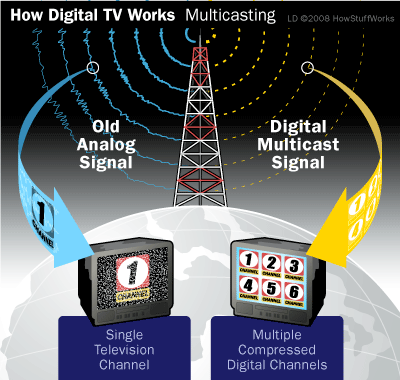
For those of us who have neither cable or satellite TV, a transformation has come that the rest of you might have missed. On June 12, the old NTSC (never twice the same color) signal disappeared, though not completely and the new digital signal, DTV, (http://www.dtv.gov/) took its place. A handful of networks (NBC and CBS among others) jumped on the bandwagon early, but for the most part, the full force of change wasn't apparent until I rescanned the tuner of the Pioneer DVD-RW-VHS machine I'd bought six months ago and to its glory it added nearly all the new channels. 3-1, 6-1,6-2,6-3, 7 (low power signal), 10 1-3, 12 1-7, 17-1,2, 29-1, my new favorite Mind TV 35 1-3 and on and on ... at least twelve more channels.

I put it to you, does anybody really need more TV than that?

And it's a high def signal that looks great on my $127 Sanyo 27" TV. It sounds great on my home audio system. This is in the same bandwidth that the old signal occupied and is incredible compared to what we used to get before cable came. Which was nada, zilch, crappo. Down the hill in the city, with poor line of sight to the Roxboro transmission towers, our reception historically sucked. We pulled in ghosted, fuzzy 10 and 12 on good days and a few of the UHF channels. When cable came on the horizon, I was an advocate. Literally. Back in the early 90's I sat on a City Council public access advisory sub-committee that worked to bring cable to Philadelphia and true public access to cable. Well, it half worked, considering that 15 years later, the house that Comcast built is the tallest building in Philadelphia and the largest cable provider in the country, while a new public access movement is still struggling to democratize the media. Good luck.

Cable. Sure, we enjoyed it for awhile, though it never had the range of programming choices and signal quality it claimed it would and I expected it to. And cable companies have never been known for their service ethic. Ancient history. To pinch pennies, I took back the $90/month box back over two years ago and never looked back. The financial savings were only part of the picture. Son 1 started a new comic strip. Son 2 took up piano. Mrs. W devours novels and I read to my sons and ... I write. More and better than ever before. I did it for the money. I did it for the family and our lifestyle. I did it for dinner conversation and the young minds. I did it for myself.

I go to dinner parties, tell friends this story, thinking I'm very out there and instead run into others, yes, even media types, who say yeah, me too; I gave up cable and never looked back. My solo back to basic protest is more like an underground movement. But don't feel sorry for us. We're not exactly sewing our own clothes and working by candlelight here. More like we're burning up the DSL line. Today, I'm ordering a Roku box and we'll be watching 500 films in my queue on Netflix "watch now" films. There are 49,500 more videos that I haven't found yet. I found Hulu and Amazon Videos on demand. I had a short dalliance with Graboid. Again, how much more do you need than that?

But back to basics. With the goofy antenna we have that looks like a Star Wars radar device we get strong, clear HD station signals, though positioning is important and sometimes we see digital lag and dropout especially during storms. But the most important thing is that we get it all free. We went from weak to no signals to clean, snow/noise-free terrestrial transmission. Yee haw. By the way. We are watching more TV since the switchover. The young people particularly, with summer upon us, must be poked and prodded to turn off the computer and TV and read or go play in the street. I too am not immune to the 'lure of the box.

I'm witnessing traditional terrestrial TV reinvented. For somebody who makes his living writing video, who has studied television from the days of Vladimir Zworkin, it's beyond cool, but it's not the only game in town. FIOS will probably obsolesce my current setup when we can get it. Which we will eventually, but can't yet.

True story.

For some inexplicable reason our leafy upscale little urban neighborhood 15 or so blocks from the old Bell of PA headquarters, can't get FIOS on some blocks. The guy up the street got so pissed because they kept him on a phone a half hour waiting to hear the news I could've told him. Nope, no fiberoptic cable here. Not yet. After waiting so long, since 1996 in fact, when Bell of PA first promised what they then unglamorously called "fiber to the curb," I'm in no hurry anymore. Funny, but 500 channels of nothing, which my parents in Pittsburgh have, is mind numbing. 50 channels of nothing is something. Something better. Something more manageable. A leap from far too much to more than enough. True innovation.

Can't forget the net. Which we all know changed everything. Lots of television to watch out there, including my current favorite. More on that later. Television has decided to grow up. In some ways it's too late. We’ve moved on. Sort of. But we're still grateful and still watching. Maybe with a little more selectivity. But we're watching. And that's the way it is.

Tuesday, July 14, 2009

Ribbon Schmibbon


"Microsoft today released a "technical preview" release of Microsoft Office 2010, the next version of the world's most widely used application suite. The beta is available to anyone who preregistered with Microsoft for a chance to download and test it. After running it for a few days of intense testing, I'm impatient for the final release." This according to PC Mag.

The author of this article might be an eager beaver--he's paid to be. As a user in the trenches, I have a different take.

I've been using MS Word since 1983, (that's right, Word for DOS) and by version 2 it was a robust program that I'd written macros for to automate many functions. I'm a scriptwriter and 2 column was not something Word did easily back then. Early in it's upgrade path, all the macro's I'd written became incompatible, hours/days/weeks wasted. I learned. So when Office 2003 came bundled with my most recent hardware upgrade, I dug in. I'm a whiz at it, I have to be. But when I try to help colleagues with 2007 and its ridiculous ribbon interface, I feel like a moron. It's not nice to make your power users feel like morons. So I stick with O'03 because I see no benefit, no enhanced functionality that makes sense to my business. This from the guy who only upgraded from DOS to Windows when it became apparent that Windows allowed functions like faxing from applications that DOS required extra software and lots of difficulty to do. People and businesses who rush to upgrade should seriously examine how and if the pretty, new upgrade enhances their own productivity. You need to look past slick interfaces, pop open the hood and be able to tick off 2-3 "must have" innovations. Even if you find real productivity enhancers, you have to balance them against what you'll lose in orphaned functions and time wasted in a new learning curve. It bites the big one-it always has bitten the big one, that MS and other developers make you completely relearn the applications you need for your daily work every two to three years. If there are no compelling reasons to upgrade, then don't. Just say no. Dig in. Join the growing ranks of software skeptics. If everybody used the same "enhanced functionality yardstick" eventually even the big software makers would catch on.
Curmudgeonly yours,


Thursday, June 25, 2009

State of the Art--circa 20th Century

If you care about the state of our nation's telecommunications infrastructure or just your own service, you should watch this Charlie Rose interview with Verizon CEO Ivan Seidenberg and then read the comment I posted. If you can't locate my response, it is reprinted below.

I've been following telco history for a while and clearly recall Bell of PA promising in the late 80's to bring fiber to the curb by 1996, not 2001 as Mr. Seidenberg suggests. And while Verizon is tearing up vast trunks of copper laid but never used under Philadelphia's Broad St. (and passing those costs on to consumers), I still can't get FIOS service to my relatively affluent urban neighborhood, a few blocks from the old B of PA HQ. Let's see. What else can't I get?

It's been raining here and the old copper junction box in the middle of my street is a rat's nest of bad splices that go out when the weather gets bad, so until tonight, my high speed internet had been mostly off 5 evenings running. While I could get a Vodafone chip to use overseas on unlocked Moto phones, there's no Verizon tech solution to get those same phones on to the proprietary Verizon network. Seidenberg's assertion that the phone makers pick and choose their networks is a little disingenuous. Telco(network and device) technologies leapfrog over previous iterations and provide jarring rather than smooth upgrade paths. If computer co's followed the same fitful model, can you imagine how few of today's (taken for granted) computing advances we’d have?

Verizon's tech support and trouble ticket resolution is often infuriating if you're a power user and I can only assume even moreso if you're not. Their upselling on FIOS packages confused the heck out of my senior citizen parents resulting in services they didn't need and hefty charges they didn't expect. It bordered on deceptive.

Seidenberg promised to roll out G4 later this year. I'm waiting to see how long it really takes and what I'll have to give up to get it. Like all of the second/third/fourth generation Baby Bell reincarnates this is still a company that only reacts when spurred by what little competition it gets. But since post-divestiture, it remains a quasi-monopoly and is largely unconcerned about competition, its primary business model is driven mostly by amortization schedules of its aging but expensive infrastructure. Consumer clamor for choice, open architecture and state-of-the-art services take a distant third as a business driver. At least in Europe and Asia, government oversight of and investment in their telco monopolies drives innovation that we stateside won't see for years. Telemedicine and other futuristic bandwidth on demand services that Seidenberg was riffing on are concepts that have been around since the 80's. Though their service is fairly reliable, it used to be better.

This not a company on the cusp of the telecommunications revolution, rather it has been dragged kicking and screaming into the 21st century. In this business sector only two things spur innovation—government oversight or true competition. Since Verizon has neither, it is content to stay its uninspired course.

Sunday, June 21, 2009

Father's Day Catch


I've never been a huge fan of this Hallmark holiday, even after I became a father. The boys do cute little handmade things which I have to get creative (clean) to find room for in my tiny office. Mrs. W found a cafe table at Lowes and I have to get creative (clean) our tiny backyard to put it to use. Today's most unexpected catch took up no room, except a bright stray byte snagged by my spam filter.

To wit:

Dear Sir/Madame,

Kindly accept my apology for sending unsolicited mail to you as I sourced your contact from a human resource profile database on your Country. I am writing you hoping that you will lend ears to my honest and sincere request due to the urgent need transfer my inheritance funds abroad for investment purpose.

I am Miss Lois Karia 22 years and the only child of my late parents Mr.and Mrs Donald Karia. My father was a highly reputable Gold and Cocoa magnet who operated in Abidjan ,the economic capital of Cote D' Ivory during his days.It is sad to say that my father passed away mysteriously as a result of poisoning during one of his business outings on 12Th February 2009. Though his sudden death was linked or rather suspected to have been masterminded by an uncle who traveled with him at that time. But God knows the truth. My mother died in 1987 when I was just 2 years old, and since then my father took me so special. My father's second marriage could not stand due to the ill treatment being given to me by the woman. Before his death on February 12 this year he called the secretary and i at his hospital bedside and told him that he has the sum of Ten Million, five hundred thousand United State Dollar(¨$10.500,000) left in fixed/suspense account in one of the leading banks Morocco. He further told that he deposited the money with my name as the next of kin, and finally issued a written instruction to his lawyer who he said is in possession of all the necessary documents of this fund in the bank. I am just a university undergraduate and don't much about financial issues. I need an account oversea were I can transfer this funds and after the transaction i will come over to your country , because I have suffered a lot of set backs as a result of incessant political crisis here in the country. The death of my father actually brought sorrow to my life and i wished to invested under your care please, particularly in the AIR LINE FIELD.

I am in a sincere desire your humble assistant in this regards so that i will leave here and have a settled life which is the wish of my father before his untimely death. Your suggestions and ideas will be highly welcomed but permit me to ask this two questions:-{1} Can you honestly help me on this without betraying me?{2} Can I completely trust you ?Note: While i am offering you 10% of the total money for this important assistance, you will also be the overseer of the investment untill i finish my education here in Morocco. I will give you a reasonable percentage from the total sum for your assistance while I pray that you do not betray me at last. Please it is important you reply me immediately for more details on the next step hence it is my wish to relocate to your country as soon as the transfer is concluded.

I wait to here from you soonest
Yours,

Miss Lois Karia.
Please send your reply to my private email: "misslois_karia@ymail.com">misslois_karia@ymail.com

Creative in the extreme-the most creative I've seen of this genre and even unintentionally funny. With it's Hamlet and Perils of Pauline references, this nuanced and tragic story got a second look from this jaded scrivener. A hit, a very palpable hit. Poor Donald, gold MAGNET that he was, probably wasn't done in by foul play by your evil uncle, but merely hit upside the head by a wayward ingot. And uh, Miss Lois, if you were 2 in 1987, that would make you 25, uh I mean 24, not 22. Either way, sorry for your loss. So here's some free words of advice. You're a creative, with sucky math skills--I can relate. You're right about one thing. You have no business managing $10.5M on your own. Forget your Morrocan education, come to the US and earn an "honest living" as a copywriter. With you to bankroll us, we can start our own full-service agency together. You have the touch and people will pay you to exercise it. Sure, this advice is free, but if you merely want to deposit something in my Morrocan account in gratitude, send me your bank routing numbers, a full-body picture and your social and we'll take it from there. You can trust me on that.

What? There's real creative networking at work here people! A little respect.