Showing posts with label Philadelphia Art Museum. Show all posts

Wednesday, April 11, 2012

Reflections of a Walker--Three Up, Three Down

Three up, three down. My after-dinner routine, 5-6 nights a week. We're talking the Rocky Steps, so roundtrip, that's 426 steps in all, not counting the long landings. I used to bring my music along, but lately, I go unplugged, to better hear what's in my head.

Steps are a metaphor for life. Steps are work done, effort expended, reward gained, new highs, interminable plateaus, repetition, repetition, religion, progress, process, meditation and more. From antiquity, we've climbed steps to seek absolution, gain power and worship gods.

These particular steps lead to Philadelphia's Art Museum, "the Parthenon of the Parkway," a temple to art. A quick, keylike turn around the fountain reveals the glittering city in expanse, at its feet. My neighborhood, Fairmount, predates the Museum's construction by a good two centuries. William Penn had originally planned to put his manor house here on the neighborhood's most prominent point. I am so spoiled, having six, now seven museums in a ten minute walk. Two of them are literally at my feet, across the street from my house.

This particular night, I did not veer across Pennsylvania Avenue, rather I stayed on it, skirting Mark di Suvero's "Iroquois," another of my favorite nightly visual markers, seen here photographed by Inquirer alumni and friend Eric Mencher. My evening peregrinations had another destination, the newest and most controversial of our "art temples," the home of the new Barnes Collection. My nocturnal crawl had become an "arts reconnaissance."


Much has been said about this building--not all of it complimentary, some of this naysaying dished by yours truly.  I called it second-class, dowdy and unworthy of its prominent place on the Parkway, Philadelphia's museum mile, which, did I mention, I am privileged to live at the crown of?


I compared The Barnes unfavorably with the Phoenix Museum of Art (same architects--Tod Williams and Billie Tsien) and wondered if it was something of an architectural slight on my people and place.  When I wrote my piece, an architect friend admonished me to keep a close eye and an open mind. So I did. I have watched The Barnes grow from a hole in the ground. Though I'm not entirely won over, lately a new notion has taken hold of me which I'm finding increasingly hard to shake.

I am not an architect or an architectural critic. But being a visual artist, living smack in the midst of a city where dramatic structures rise up with some regularity makes it hard to be neutral or ambivalent to your surroundings. You take sides. You form attachments. You walk the beat and research with your eyes, ears and feet. So, what I've been grappling with is the idea that perhaps The Barnes is not an architectural mediocrity after all. Quite possibly, it is a work of subtle and compelling genius.

Friday, October 9, 2009

The Curse of Dr. Barnes

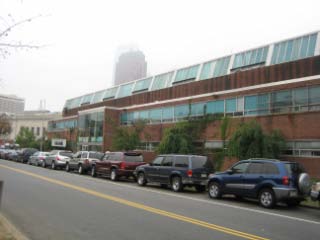
Before


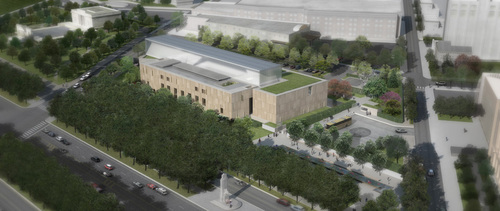
After

The Barnes Foundation, according to its own website "is home to one of the world's largest collections of Impressionist, Post-Impressionist and early Modern paintings, with extensive holdings by Picasso, Matisse, Cézanne, Renoir and Modigliani, as well as important examples of African sculpture."

The design for the new home of the worldclass impressionist collection amassed by the uber-contentious Dr. Al Barnes bears an eerie and unwelcome resemblance to the Juvenile Detention Center which it replaces.

A Bit of Barnesian Background
The Barnes Collection has one of the most embattled legacies in the history of American art collection, even inspiring a movie with the overwrought title “The Art of the Steal."  The good doctor who died in 1951, made a fortune in nostrums and patent medicines. He also had a true talent for shopping in Europe and managed to scoop up a lot of "bargain basement" art at firesale prices.  I haven't seen "The Art of the Steal." I wonder if it even touches on how this shiny collector and creator of Argyrol, nickled the starving artists whose works he bought for a song. But that's art in the age of commerce for you--a sad tale, but scarcely worth a historical footnote.

What makes the infamous Barnes backstory fascinating is that Doc B had no great love of the city and its business and cultural leaders. Seems they turned up their narrow blue noses at his self-made, new money social ascendancy, so he got his payback. Using his collection as a sort of cultural hostage, he forged a will he clearly intended to be unbreakable. Then he used it as a hammer to hit the art establishment over the head with, long after he was gone. Basically, the will said that The Collection could never:
  • Be broken up
  • Exhibited/toured
  • Or worse, moved!
Call it karma, but Barnes died of a tragic auto accident, his legacy still very much in flux. One wonders if he was a victim of self-inflicted road rage. While other private art foundations manage quite well, the Barnes made the news with its odd choice of stewardship and its court battles. Today, Dr. B may be heartened that his unquiet spirit transmigrated to cohabit with certain quixotic forces who still battle to prevent the collection's move.

Maybe a hundred years hence, the Barnesiacs and the township of Merion will band together and take a page from the Egyptians who after decades of righteous contention, were able to repatriate their priceless antiquities from the Louvre.  The fact is that languishing out in leafy Merion, PA, mired in restrictive visitation policies, the prickly half-love of its neighbors and the bizarre internecine politics of its dysfunctional board, the Foundation and its Collection was drowning in red ink. The Pew and the Lenfest Foundations stepped in and threw Barnes a lifeline, but the bailout inked a devil's deal. It required the collection to move to the city where it can finally be appreciated by Philadelphia residents and visitors without special papal dispensation.

This battle waged famously for years in Philadelphia Orphan's Court. Recently Barnes' grudge-drenched will was broken in a gust of sulfur and smoke and what I'm sure are several legal precedents. Philadelphia Lawyers may moan, but art lovers of all stripes are the beneficiaries. Albert Barnes' vitriol was ultimately his foundation's aqua regia.  The experience of the Barnes an object lesson in how even great philanthropy can run aground when a benefactor's nits and gripes overshadow a more expansive, enduring vision of contribution to society. Anger, art and philanthropy make for a gritty salad.

I'm just a little guy with a big mouth and I doubt I'll ever be able to put the following principle to the test. But I believe that if you have the resources to acquire great art, it comes with an implicit noblesse oblige to share your spoils with society. What Barnes did was like commissioning a Mozart symphony, then restricting its performance to his basement. Great art demands the greatest possible audience--access by ordinary people who would be its patrons. Not an elite few. However much money and power you have, you can't narrowcast a cultural legacy in perpetuity. That's the nutshell. Now back to the future.

The House that Barnes Didn't Build

Call it "the takeover of the imperial art establishment" or just call it inevitable triumph of good sense; it seems in any case to be a done deal, a baked cookie. What feels half-baked, is the design by Todd Williams and Billie Tsien. Look at their spectacular design for the Phoenix Art Museum then come back and compare. Though in an Inquirer online reader feedback poll people seem to prefer the new design by a large margin, I ask:

'Where is the visual drama worthy of the collection?'

Why must so much Philadelphia architecture be confined to pedestrian brick and stone? Why don't the commissions who rubber stamp blandchitecture like this have the cojones to point the fancy out-of-town architects back to their drawing boards with the stern admonition to really "bring it" next time. Don't the architects who design for this city have more contemporary and uplifting materials in their palettes?  In the case of Williams and Tsien, they do, they just ain't sharin' it with Philly. Everywhere I go in Philly, I see new buildings going up that look like more of the same. They think they're reflecting the spirit of the city, when in my humble, each new uninspired brick and stonefaced edifice reinforces an anti-progressive, provincial frumpiness this city is trying so hard to shake off.

It's not that I'm looking for wild radicalism like Frank Gehry's scary metal monster in Bilbao, though love it, hate it, or think it resembles a Transformer, at least it makes a impression. Inga Saffron, whose every opinion I normally dote on like a starry-eyed fanboy, praised the punched windows resembling those in the facade of the Barnes' neoclassical home in Merion.


Yawn. So what? A handful of punched windows aren't going to mollify the Barnesiacs who'd rather see their precious collection shuttered than exhibited the way worldclass art should be.

What is the virtue of such nostalgic tribute when weighed in the balance with an opportunity to create a bold, visual exclamation point to Philadelphia's aspirations to evolve as a center of art and culture?  We deserve better.

Don't get me wrong, I am gladdened that this historic collection is finally about to be wrested out of its snuggery in the Land of Lockjaw, but it should come downtown and present its face to the Parkway. It should announce itself with drama and pride, not landscaping.

I walk The Parkway nearly every day. This corridor, one of my favorites in a gloriously walkable city, has so much potential. Yet I fear it will never be as grand as it could be, especially if one of its anchor tenants turns its face away.

"It is an absolutely masterful design. Those who don't understand the design are looking at it from a selfish point of view," according to Moe Brooker of the Philadelphia Art Commission.
I'm just a selfish guy. Well harumph!

Am I missing something?
I think not.
I think the old curmudgeon has spun twice and is now cackling in his grave.
Maybe there's another movie in it
Call it, "The Revenge of Dr. Barnes."
Too bad Vincent Price isn't around to play the lead.

Tuesday, July 22, 2008

Walking Man 1


I'm a writer, which immediately qualifies me as the most sedentary of schleppers. Six years ago my lack of mobility, love of food and thickening waistline earned me a diagnosis of diabetes, the American Lifestyle Disease. Having two adult onset diabetic parents with failing health and a grandmother who died of the disease, I could hardly claim ignorance about the longterm consequences of the disease. I took a contrarian view. I took my diagnosis as a wakeup call and thus my goal with the help of a good doc, was to create gradual, sustainable and significant change in those aspects of my lifestyle that were and are risk factors. Serious walking began simply as an attempt to fold daily errands, stress reduction and vigorous exercise into my otherwise deskbound day. My Walkable City, Philadelphia, rewarded my efforts and spread its bounty before me.

The recent buzz about urban walkability ratings has jump-started this blogline, which up to now has existed only in my head (and feet). I haven’t figured out how to walk and write at the same time, but I’ve come close.

Nearly every day at 5:00, my eight year old son and I step out our front door and cross two busy streets. We’re off to collect Mom who works at the University of PA, Presbyterian Hospital 2.5 miles from our house. The boy and I both have our MP3 players plugged in and are enjoying our own private soundtracks. Mine has about 2000 songs. I don’t know if I’ll be listening to Leonard Cohen, Arvo Paart or Deep Purple. The random surprise of shuffle selection is the joy of it. Perhaps it fits that I also find the jangling hustle bustle of the city soothing. I’ve plugged in my musician-quality Shure E-4c earbuds, which when properly inserted in the ear canal, immediately knock out about 70% of the ambient noise while allowing me to enjoy the full tonal range of my music without cranking it.

Some folks think I’m irresponsible or shutting myself off from the world, but I’ll tell you it’s bliss. A bus rumbles by and I do hear it, but at quarter strength. Somewhere, a wailing fire engine closes in but I feel none of the instinctual panic you experience in your chest as the decibels build to a throbbing scream in your head. I live in the city. I don’t need any more noise. I have a choice about what goes in my ears, soundwise. It’s incredibly liberating. But this splendid aural isolation comes at a modest cost of increased visual acuity. “Look both ways before you cross the street. Then look again.” Mom said it and well into my second half century, these are good words to live by. The boy and I hold hands and communicate with gestures and hand signals. His stride is two steps to my one, but his pace is flowing and easy, a sort of skipping run. He enjoys this as much as I do. We fall quickly into a rhythm. I shift hands with him, to keep him on “the inside,” my body shielding his from oncoming traffic of any sort.

I share my own, more cautionary version of Mom’s bromide with both my boys. “Assume the people flying past you in their cars are psychos or idiots and can lose control of their cars in a split second. Pay attention and live.” A tad dramatic perhaps, but a little paranoia is healthy when it comes to navigating urban byways.

At this point, if I were just walking for pleasure, I'd have all kinds of choices. I’m on one of dozens of access points to the world's largest urban park. I can travel north or south along the Schuylkill River, a well-used recreational waterscape, where Ben Franklin himself picnicked and frolicked with his lady admirers. I could follow the river away from or directly into the leftbank heart of the city. Or I can climb the hill behind the Art Museum which winds through a Victorian walker's garden with its gazebo and trails, running back up to the museum which occupies the site of the Philadelphia Waterworks, the nation's first urban waterworks, the architectural and scientific marvel and travel destination of the 18th century. Heading west, I then cross the Spring Garden Street bridge, with its commanding northward view of the river, the museum and the waterworks, all which when seen by sunset, recall the colors of Sienna. The southward view is dominated by my favorite view of the Philadelphia skyline.

This may be a bit of hometown hubris, but frankly I'm surprised that Philadelphia ranks lower than New York and San Fran. in walkability. Maybe I and the study's authors have different definitions of walkability. I've been telling people for years that this is the most walkable city in the country and I stand by it. I've visited and walked them all, with the exception of Portland. The reasons for my preference are myriad. First of all, walking for me is a 20-30 mile per week activity. I average about 5 miles per hour. Try maintaining that pace in NYC and not slowing, dodging or colliding with other pedestrians. Hey you, I’m walkin’ here!

Don’t get me wrong. I love New York, love walking in it, eating in it, doing business or just having fun in it. New York is many bigger and better things, but more walkable than Philadelphia, it is not. To me, it boils down to modulation. New York’s skyline is so straight up and down, so constricted that even the parks and open spaces feel hemmed in. Not so here. Here the skyline offers, well, sky, room to breathe. Here a building can be appreciated, in context, like Cesar Pelli’s changeable magnificent Cira Center which maintains a dynamic ever-shifting dialogue with earth and sky. In New York it would be compressed into the same space with a dozen other buildings, all just as magnificent perhaps, but battling each other for eye-space, lost to their own scale. Here Cira and I have room to breath, to interact. So I greet it every day. It talks back to me. I feel we have a relationship.

Like many walkable urban neighborhoods, there are dozens of charming restaurants and shops less than mile from my doorstep. But here, Billy Penn’s rigorous, revolutionary gridwork of streets means that even the first time (walking) visitor stands little chance of getting lost. Several dramatic diagonal avenues, former farmer’s market pikes, radiate into or out of the city, (depending on your perspective), the most notable of these is the Benjamin Franklin Parkway, which in a few years, will, I predict, come to resemble Barcelona’s Las Ramblas in scale, grandeur and pedestrian amenities. Though its lights aren’t the most pedestrian-friendly, the BFP makes City Hall an easy 20 minute destination from my home in Fairmount. Philadelphia’s terrain is neither completely flat like Chi town’s, yet not so demanding that one needs bionic calves to handle the ascensions and declensions of say San Fran.

Not that my calves can’t handle the Golden City, thank you, it’s just that again, maintaining a sustainable pace is critical to my definition of walkability and walking as exercise. So is the aesthetic experience of it, the sense of variable, visual modulation, the confluence of greenery, open sky, open ground, dramatic vistas, urban structures and urban cultural amenities. In addition, Philadelphia has what few other of America's most walkable cities have and that is arguably the most extensive historical pedigree in the country, little gems of which constantly reveal themselves with little effort on the part of the observant walker. I imagine a future which I long for, but will probably never see, of walking these fair streets and byways, unperturbed by the infernal combustion machines that dominate the roads—for now.

Don’t get me wrong. I have a late model Toyota Avalon that I love and maintain like some guys pamper their sportier rides. I’ve put all of 10,000 miles on a year on it. I have already, by lifestyle and preference, reduced my “carbon footprint.” My only problem is when I have to suck in some of yours.

On the Spring Garden Street Bridge, we hold our breath to inhale a bit less of the blue gray sulfurous spew coming from a particularly noxious SUV with a failing transmission. Will the vehicle even make its destination? Do I know something that the driver doesn’t?

Perhaps not, but I do have a theory. It came to me on the Spring Garden Street Bridge while watching drivers jockeying to make the turn onto the Expressway down ramp. I’ve come to believe that learning to drive a car was the first step to the emotional distancing that allowed Air force pilots to carpet bomb entire villages in Vietnam, then blithely suck down cold beers in Saigon officers’ clubs an hour later. Conversely keeping feet on the street keeps you connected in ways too intimate for some people to handle. The more machine you put between yourself and your own transport, the more distanced you are. The boy and I stand with a commanding view of the Schuylkill Expressway, watching the spasmodic progress of what I call the red snake and its opposing cousin, the white snake. It’s hard to imagine all the individuals in all those cars as singular entities rather than just segments of the snakes.

Imagine all this, without cars, I tell my son. He’s heard it before. The power and the clarity of the idea make us pause. Perhaps it’s just the fumes. I heard today that GM’s quarterly earning statement had plunged. Corporate spokespeople said and I quote, they were “caught offguard by declining sales and Americans’ efforts to conserve fuel by buying smaller and fewer vehicles.” Caught offguard???? It must be a real talent to say something like that and not look incredibly stupid doing so. Then again, I guess if you manufacture Hummers, there’s lot about sustainable transportation choices that will catch you offguard. It’s just like the 70’s, just 30 years later.

BTW, I've been off diabetes meds for over a year and have managed my disease into remission by diet and exercise alone. I've lost 60 pounds and all the aches and pains that I used to get in my knees and legs are gone. I have, in my own opinion at least, America's most walkable city to thank. Sign me, the Philadelphia Walking Man

Tuesday, September 4, 2007

The Art Palace In My Front Yard

Inga Saffron is the architecture critic for the Philadelphia Inquirer. While I find that on a whole that the quality of reportage, particularly international reportage has plummetted after the Inky was taken over by Philadelphia Media Holdings and its dark lord, Brian Tierney, Ms. Saffron's star remains undimmed. Ms. Saffron through her Changing Skylines column does what a big city daily should do, shed light and occasional heat on issues that affect urban life. Now as far as architecture goes, the closest thing to an education that I ever got was to hang out and get wasted with architect friends. That is until I made Ms. Saffron's article a weekly "must read" and began to take a proprietary interest in the skyline of my adopted City of Brotherly Love.


This particular piece of skyline is right out my front door and if proximity confers some sense of entitlement or ownership, then her most recent review, Art Palace is Right Fit with Philadelphia is a perfect fit for me.


My architect friends agree that in Ms. Saffron, that Philly has a worldclass observer of public spaces. As people who have lived with the Fidelity/Reliance cum Perelman for 23 years, Mrs. W and I have some history with the building and on the whole are thrilled with what it has become. Given that this structure is the second home of one of the nation’s premiere museums, it is right to hold it to a higher standard.

I must admit that when I first saw the concrete block of the new addition, I was dismayed. I imagined that somewhere, a building materials order got flummoxed and a suburban Walmart got our Perelman order and we got theirs. (Note the liberal use possessives.) But humble concrete can be a tabula rasa and when I saw the metal grid on the 25th street side with the climbing flowering vines, I had a little aha moment and walked away with a smile on my face.

I had another even more intense aesthetic experience after the construction barriers, trailers and fencing were cleared away to reveal a broadened gleaming pedestrian expanse along the Fairmount-PA Ave intersection. Because of its scale and lighting it is serving as a lively, impromptu community hot spot, where on one particular mid-summer evening, while chatting up the museum’s director of housekeeping, a neighbor, I observed Art Museum Director Anne d'Harnoncourt and a neighborhood mom confer on dog training strategies. This is a nexus where we neighbors regularly connect in little Jane Jacobian moments on our way to and from our errands and walks.

There is one sore spot on this lovely walkway and perhaps it takes a neighbor with a couple decades of walkby experience to point it out. Our new neighbors should know that in my 20+ years of observing, nothing has ever flourished in the little strip of earth that parallels the “moat” wall. The previous owners planted boxwoods which, try as they might, through multiple replantings, always withered after a couple of seasons. The same pretty vines that seem so happy on the 25th Street side are dying wretched deaths in that parched little strip of cursed earth along PA Avenue.

Most folks I talk to agree that the work of the landscapers has fallen far short of expectations. Even the streetside lot on 26th, which is a quantum improvement in terms of eye appeal, was poorly executed when it came to laying down an appropriate soil base and proper planting. One day it was a bare construction trash strewn network of pits and trenches. The next day it was planted. The plants there now struggle and show the ill-effects of rushed, slipshod planting techniques. Several cute little rhododendrons have already succumbed. We’re also a bit perplexed that the lovely honey locust and black locusts that were planted along 25th, Fairmount and PA Ave were not extended back along the Meredith St. expanse of the Perelman. What, just because it doesn’t face the more trafficked avenues, it isn’t worthy of modest finishing touches? The museum needs to call its landscapers on the carpet to remedy these oversights. What they’ve done, or more to the point, what they haven’t done, is unworthy of this public space.

The most glaring oversight is the “temporary” PECO pole that furnished power to the construction machines, but now stands, an ugly sore digit, disconnected from the grid and ready to be extracted. But it hasn’t been and nobody can tell me when it will be. I buttonholed the project manager and he asked me if I had any pull with PECO and we both laughed at the irony in his question. Perhaps Ms. d'Harnoncourt herself should get on the phone and work her way up the electric utility’s chain until this sore tooth is yanked. If you google my address, you’ll see why this particular piece of unfinished business is most galling to us. Before the construction, we had a beautiful, unobstructed view of the northwest face of the museum proper and its sycamores. The lot used to be a blacktop sea of cars, parked two or three to the space. We now have a lovely view of the locust trees and shrubbery of the lot. On the whole, a vast improvement. Then standing smack in the middle of our transom window is this bare ugly projection which resembles nothing so much as a rudely upthrust Brobdingnagian middle finger. It is a visual insult that we endured while it was needed and as it no longer serves any purpose, it has to go.

Finally, I chatted up Inky staff shutterbug Michael Bryant when he was taking his photos in preparation for Inga's article. His 7th picture (on the philly.com site) shows the interior view of the ventilation stack and I agree with Ms. Saffron's assertion that it is butt ugly and inexcusable. Imagine in its absence, the light and the view of that pretty brick, tree and sun-dappled piece of 25th St. looking out or the lovely view of the museum’s atrium looking in. It could have been a lively and enduring visual comment on how a cultural landmark and its resident neighbors interact and instead it looks like an architectural mooning (and I’m not talking astronomy) to the genial neighborhood that has for the most part, endured the three years of construction with patience and good grace. The architect had the Perelman's huge interior space to work with that would have been invisible from the street. What WAS he thinking?


Even more inexplicable and you can see it from Mr. Bryant’s photo, are the uneven flashing, the ladder and rag, (if that’s what these are) sticking up from the top. Walking up 25th St. one eerie moonlight night, the glint of the ladder and the rag flapping in the wind caught my eye and sent a chill down my spine. I had to stop and stare down this grim trompe-l'œil for several minutes because it looked for all the world like the malevolent scarecrow in Dennis Potter’s The Singing Detective. (It was a lot darker and creepier then, trust me.)

I can’t claim to always understand art, but I sometimes wonder if I understand architecture even less.