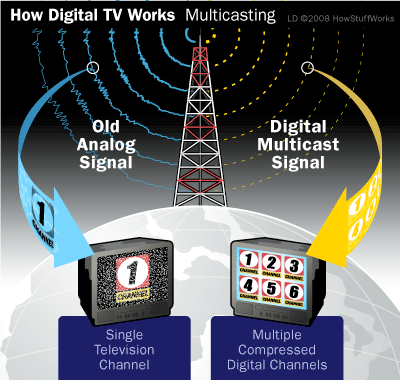
For those of us who have neither cable or satellite TV, a transformation has come that the rest of you might have missed. On June 12, the old NTSC (never twice the same color) signal disappeared, though not completely and the new digital signal, DTV, (
http://www.dtv.gov/) took its place. A handful of networks (NBC and CBS among others) jumped on the bandwagon early, but for the most part, the full force of change wasn't apparent until I rescanned the tuner of the Pioneer DVD-RW-VHS machine I'd bought six months ago and to its glory it added nearly all the new channels. 3-1, 6-1,6-2,6-3, 7 (low power signal), 10 1-3, 12 1-7, 17-1,2, 29-1, my new favorite Mind TV 35 1-3 and on and on ... at least twelve more channels.
I put it to you, does anybody really need more TV than that?
And it's a high def signal that looks great on my $127 Sanyo 27" TV. It sounds great on my home audio system. This is in the same bandwidth that the old signal occupied and is incredible compared to what we used to get before cable came. Which was nada, zilch, crappo. Down the hill in the city, with poor line of sight to the Roxboro transmission towers, our reception historically sucked. We pulled in ghosted, fuzzy 10 and 12 on good days and a few of the UHF channels. When cable came on the horizon, I was an advocate. Literally. Back in the early 90's I sat on a City Council public access advisory sub-committee that worked to bring cable to Philadelphia and true public access to cable. Well, it half worked, considering that 15 years later, the house that Comcast built is the tallest building in Philadelphia and the largest cable provider in the country, while a new
public access movement is still struggling to democratize the media. Good luck.
Cable. Sure, we enjoyed it for awhile, though it never had the range of programming choices and signal quality it claimed it would and I expected it to. And cable companies have never been known for their service ethic. Ancient history. To pinch pennies, I took back the $90/month box back over two years ago and never looked back. The financial savings were only part of the picture. Son 1 started a new comic strip. Son 2 took up piano. Mrs. W devours novels and I read to my sons and ... I write. More and better than ever before. I did it for the money. I did it for the family and our lifestyle. I did it for dinner conversation and the young minds. I did it for myself.
I go to dinner parties, tell friends this story, thinking I'm very out there and instead run into others, yes, even media types, who say yeah, me too; I gave up cable and never looked back. My solo back to basic protest is more like an underground movement. But don't feel sorry for us. We're not exactly sewing our own clothes and working by candlelight here. More like we're burning up the DSL line. Today, I'm ordering a
Roku box and we'll be watching 500 films in my queue on Netflix "watch now" films. There are 49,500 more videos that I haven't found yet. I found Hulu and Amazon Videos on demand. I had a short dalliance with Graboid. Again, how much more do you need than that?
But back to basics. With the goofy antenna we have that looks like a Star Wars radar device
we get strong, clear HD station signals, though positioning is important and sometimes we see digital lag and dropout especially during storms. But the most important thing is that we get it all free. We went from weak to no signals to clean, snow/noise-free terrestrial transmission. Yee haw. By the way. We are watching more TV since the switchover. The young people particularly, with summer upon us, must be poked and prodded to turn off the computer and TV and read or go play in the street. I too am not immune to the 'lure of the box.
I'm witnessing traditional terrestrial TV reinvented. For somebody who makes his living writing video, who has studied television from the days of Vladimir Zworkin, it's beyond cool, but it's not the only game in town. FIOS will probably obsolesce my current setup when we can get it. Which we will eventually, but can't yet.
True story.
For some inexplicable reason our leafy upscale little urban neighborhood 15 or so blocks from the old Bell of PA headquarters, can't get FIOS on some blocks. The guy up the street got so pissed because they kept him on a phone a half hour waiting to hear the news I could've told him. Nope, no fiberoptic cable here. Not yet. After waiting so long, since 1996 in fact, when Bell of PA first promised what they then unglamorously called "fiber to the curb," I'm in no hurry anymore. Funny, but 500 channels of nothing, which my parents in Pittsburgh have, is mind numbing. 50 channels of nothing is something. Something better. Something more manageable. A leap from far too much to more than enough. True innovation.
Can't forget the net. Which we all know changed everything. Lots of television to watch out there, including my current favorite. More on that later. Television has decided to grow up. In some ways it's too late. We’ve moved on. Sort of. But we're still grateful and still watching. Maybe with a little more selectivity. But we're watching. And that's the way it is.

 Did I ask you for your love?