Thursday, July 30, 2009

Attack of the Insult Comics

Watching the kids watch shows like "America's Funniest Videos" with our newfound over the air broadcast TV; you realize how breathtakingly cruel and stupid people will be to each other to get a laugh. Parents will abuse their own children. Children their parents. And everybody turns on the animals. It's shocking. Disgusting. What does it say about us? Where are the light, naive days of "Candid Camera"? Certainly not in the opening of Sacha Baron Cohen's newest chien andalou. All the typical trots are trotted out against Cohen, but I take my own counsel. Most times I find him eerily repulsive. Except when he makes me laugh, which is more often than I'd care to admit, particularly with my teenage son present. The kids worship him without the reserve adults grit teeth over. And the grown ups, the people who should know better, just keep falling right down into his little nightmare hole, like flies to a Venus fly trap. They never emerge unscathed. It's funny as hell, if you can get past the fact that the anti-social behavior is neither real nor staged, but something grayer in between, the product of a very clever, but warped mind. So not surprising, that Ron Paul, and Boutros (Boutros) Boutros Ghali no particularly dim bulbs were stung by Mr. Cohen. In his Sixer's shirted Ali G guise, Cohen has nailed celebrities, newsmakers and world leaders of all stripes and subjected them to the most inarticulate outrageous bigoted abuse, disguised as interview journalism. When interviewed himself, as by Terry Gross a couple of years ago, he articulates a daring vision of comedy, a candid camera farce/assault for the digital age. As uncomfortable as his button pushing makes us, there are a couple of reasons at least to like this guy. He uses the media to tweak power and celebrity in ways we ourselves only wish to. He is this generation's Chaplin, a true subversive.

But you didn't hear me say that because I've been watching some of my must see TV away from the broadcast box. TG for Hulu. It enabled me after five years of delayed gratification, to fall hopelessly under the spell of a show I wasn’t even sure I’d like. I was fortunate enough to come well under Hulu’s June 14th deadline and in a concerted three week marathon, went from Season 1 to Season 5 of FX's amazing "Rescue Me", starring Denis Leary, Callie Thorne and the luminous Andrea Roth. Never have a more compelling, ###'ed up group of characters inhabited the small screen. Mr. Leary and producer partner Peter Tolan have appropriated the tragedy of 9/11 and given it a human scale and trajectory through the lives and loves of the NYC firefighters of Truck 62, a group of, in the words of character Franco Riviera, “the brotherhood of dysfunctional action junkies.” The show is bracingly un-PC and with its "pinned to the edge" explicit depictions of all the darkest nooks and crannies of the human psyche, it must give even the liberal FX morality police agita. Janet Jackson got fined for a nipple slip. The FCC must be watching "Rescue Me" closer than I do. Hopefully, with a new administration, they have their own must see TV and will leave mine alone.

The leader of this pack of dogs is Tommy Gavin, as played by Mr. Leary. Turns out I had him all wrong. Leary and I are the same age. He’s the type of macho wiseass guy who picked on my type of guy as a kid. At the beginning of his career, it seemed he was just another insult comic, an indoor sunglasses wearing, sneer-faced, Dice-Clay cloned Mick comic more known for profanity- drenched humor than serious work. IMH. Oh, but in “Rescue Me” his ghosts and demons leap, dance and blaze all over the screen and it is absolutely gut-wrenching and mesmerizing. Like watching luxury cars crash in slow motion.

Wherever he goes, whether to the firehouse, his own uneasy bed, or the kitchen of his lover, Leary’s Gavin lugs his Marleyesque purgatory train, the visible, trash talking, punch throwing ghosts of Jesus, his dead cousin, brother and father as well as civilian others who've perished in flames Tommy has fought with so little regard for his own life. At first I thought the device a little obvious, but I soon realized that Tommy’s ghosts are Leary’s first clue that his asshole alpha stud puppy alter ego is human, sympathetic and far frailer than maybe even the talented Mr. Leary is willing to concede.

Tommy's on again, off again, on again affair with the bottle is one only an AA lifer could fully conceptualize. You feel the burning ache of his thirst in the back of your own throat as he contemplates a fifth of vodka, pours the tumbler, raises it, sets it down, raises it again, all the while screaming "Don't do it Tommy boy!" Still the guy is an asshole and his own worst enemy. He is a mysogynist. He burns all his bridges, buys his kids' love with money and undermines everybody who cares for him. What a paradox! I care so deeply for him and his whole band of merry misfits. ( I hope he never finds out!) I love when a character, through the integrity of the writing, rises from the table, like Frankenstein’s monster, a creature far greater than the sum of his parts. Denis, I hardly knew ye. But man, am I impressed!

Unlike Leary, Callie Thorne is an actress whose career I have followed for decades, before she played long-suffering Elena McNulty, wife to serial destructo boy detective Jimmy McNulty on HBO’s critically heralded “The Wire” and before that, Det. Laura Ballard on NBC’s amazing six year, ‘90’s-era “Homicide, Life on the Streets.” With her trademark sexy vulnerability and toughness, she stole scenes, shone in these relatively minor roles, playing second fiddle to bigger names and storylines. In every role she plays, you feel her absences from the screen like gravity and wait impatiently for her return.

Mr. Leary, to his eminent credit, understands this. He trained the spotlight and let slip the leash that other directors and writers have restrained the incredibly talented Ms. Thorne with and she leaps to deliver, oh God does she deliver as Sheila, the predatory, over-the-top, head-case, pill-popping, sex-starved, Tommy-loving widow of Gavin clan cousin, Jimmy Keefe, the firefighter who died in the second WTC tower’s collapse. In bed, in a chair, on a table, on the floor, she is every bit Leary’s femme foil and like him, displays no fear in her exploration of desire and fallibility. I can’t take my eyes off her. I would give body parts to watch Thorne and Leary rehearse. I think I'd finally truly get the writer/actor connection.

They are as unlikable a group of characters as you’d ever want to meet.

They are as lovable a group of characters as you’d ever want to meet.

I now wait with bated breath, hook and ladder, for Wednesday early, early mornings, when the previous week’s show is posted by FX after an agonizing eight day delay.

Another Hulu offering I didn’t think I’d warm to is Showtime’s “Dead Like Me” which I assumed would be yet another death-trip rip-off of HBO’s wildly popular “Six Feet Under.” Again, I got it wrong and I happily report I’m in love with 28 year Ellen Muth, who plays, no carries the show, as pug-faced, saucer-eyed 19 year old Georgia, a college drop-out office drone who is freakishly and summarily dispatched by a Russian space station toilet seat turned fiery reentry debris. For reasons that aren’t entirely clear, instead of meeting her eternal reward, the unfinished George, aka "Toilet Seat Girl" is pressed reluctantly into yet another dead end job as an undead case worker, a grim reaper who harvests the souls of the living, seconds before their often gory denouements. The reaper squad receives daily assignments from the bureaucracy of death, but no pay or expense account for their grim but merciful tasks. So they must resort to some sordid and hilarious scavenging to keep it going 9-5 in the land of the living. Clever, though the writing isn't yet near as crisp or insightful as "6 Feet," yet it has its moments and the camera loves Muth. With her rolling eyes, deadpan voiceovers and fixed scowl turned smile; she outshines even thespier thesps Mandy Patinkin and Jasmine Guy, episode after episode. Watch this dead little lady rise like a phoenix.

It’s shows like these that make the last two decades the true golden era of the little screen. As long as talented writers and actors are allowed to parade and exorcise their demons on the little box, I will keep watching, far into the night, cheating sleep and drawing inspiration as I seek out the clues and tools for mining the veins buried deep in my own dark writer's heart. Television drama, written by writers, acted by actors, like reality, only better.

Thursday, July 16, 2009

I want my DTV?


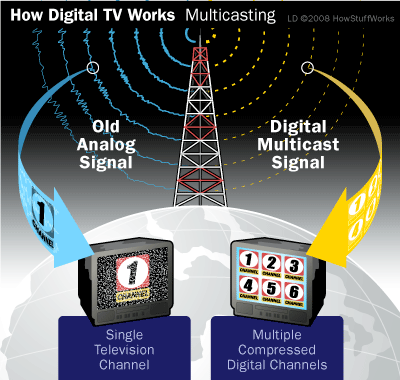
For those of us who have neither cable or satellite TV, a transformation has come that the rest of you might have missed. On June 12, the old NTSC (never twice the same color) signal disappeared, though not completely and the new digital signal, DTV, (http://www.dtv.gov/) took its place. A handful of networks (NBC and CBS among others) jumped on the bandwagon early, but for the most part, the full force of change wasn't apparent until I rescanned the tuner of the Pioneer DVD-RW-VHS machine I'd bought six months ago and to its glory it added nearly all the new channels. 3-1, 6-1,6-2,6-3, 7 (low power signal), 10 1-3, 12 1-7, 17-1,2, 29-1, my new favorite Mind TV 35 1-3 and on and on ... at least twelve more channels.

I put it to you, does anybody really need more TV than that?

And it's a high def signal that looks great on my $127 Sanyo 27" TV. It sounds great on my home audio system. This is in the same bandwidth that the old signal occupied and is incredible compared to what we used to get before cable came. Which was nada, zilch, crappo. Down the hill in the city, with poor line of sight to the Roxboro transmission towers, our reception historically sucked. We pulled in ghosted, fuzzy 10 and 12 on good days and a few of the UHF channels. When cable came on the horizon, I was an advocate. Literally. Back in the early 90's I sat on a City Council public access advisory sub-committee that worked to bring cable to Philadelphia and true public access to cable. Well, it half worked, considering that 15 years later, the house that Comcast built is the tallest building in Philadelphia and the largest cable provider in the country, while a new public access movement is still struggling to democratize the media. Good luck.

Cable. Sure, we enjoyed it for awhile, though it never had the range of programming choices and signal quality it claimed it would and I expected it to. And cable companies have never been known for their service ethic. Ancient history. To pinch pennies, I took back the $90/month box back over two years ago and never looked back. The financial savings were only part of the picture. Son 1 started a new comic strip. Son 2 took up piano. Mrs. W devours novels and I read to my sons and ... I write. More and better than ever before. I did it for the money. I did it for the family and our lifestyle. I did it for dinner conversation and the young minds. I did it for myself.

I go to dinner parties, tell friends this story, thinking I'm very out there and instead run into others, yes, even media types, who say yeah, me too; I gave up cable and never looked back. My solo back to basic protest is more like an underground movement. But don't feel sorry for us. We're not exactly sewing our own clothes and working by candlelight here. More like we're burning up the DSL line. Today, I'm ordering a Roku box and we'll be watching 500 films in my queue on Netflix "watch now" films. There are 49,500 more videos that I haven't found yet. I found Hulu and Amazon Videos on demand. I had a short dalliance with Graboid. Again, how much more do you need than that?

But back to basics. With the goofy antenna we have that looks like a Star Wars radar device we get strong, clear HD station signals, though positioning is important and sometimes we see digital lag and dropout especially during storms. But the most important thing is that we get it all free. We went from weak to no signals to clean, snow/noise-free terrestrial transmission. Yee haw. By the way. We are watching more TV since the switchover. The young people particularly, with summer upon us, must be poked and prodded to turn off the computer and TV and read or go play in the street. I too am not immune to the 'lure of the box.

I'm witnessing traditional terrestrial TV reinvented. For somebody who makes his living writing video, who has studied television from the days of Vladimir Zworkin, it's beyond cool, but it's not the only game in town. FIOS will probably obsolesce my current setup when we can get it. Which we will eventually, but can't yet.

True story.

For some inexplicable reason our leafy upscale little urban neighborhood 15 or so blocks from the old Bell of PA headquarters, can't get FIOS on some blocks. The guy up the street got so pissed because they kept him on a phone a half hour waiting to hear the news I could've told him. Nope, no fiberoptic cable here. Not yet. After waiting so long, since 1996 in fact, when Bell of PA first promised what they then unglamorously called "fiber to the curb," I'm in no hurry anymore. Funny, but 500 channels of nothing, which my parents in Pittsburgh have, is mind numbing. 50 channels of nothing is something. Something better. Something more manageable. A leap from far too much to more than enough. True innovation.

Can't forget the net. Which we all know changed everything. Lots of television to watch out there, including my current favorite. More on that later. Television has decided to grow up. In some ways it's too late. We’ve moved on. Sort of. But we're still grateful and still watching. Maybe with a little more selectivity. But we're watching. And that's the way it is.

Tuesday, July 14, 2009

Ribbon Schmibbon


"Microsoft today released a "technical preview" release of Microsoft Office 2010, the next version of the world's most widely used application suite. The beta is available to anyone who preregistered with Microsoft for a chance to download and test it. After running it for a few days of intense testing, I'm impatient for the final release." This according to PC Mag.

The author of this article might be an eager beaver--he's paid to be. As a user in the trenches, I have a different take.

I've been using MS Word since 1983, (that's right, Word for DOS) and by version 2 it was a robust program that I'd written macros for to automate many functions. I'm a scriptwriter and 2 column was not something Word did easily back then. Early in it's upgrade path, all the macro's I'd written became incompatible, hours/days/weeks wasted. I learned. So when Office 2003 came bundled with my most recent hardware upgrade, I dug in. I'm a whiz at it, I have to be. But when I try to help colleagues with 2007 and its ridiculous ribbon interface, I feel like a moron. It's not nice to make your power users feel like morons. So I stick with O'03 because I see no benefit, no enhanced functionality that makes sense to my business. This from the guy who only upgraded from DOS to Windows when it became apparent that Windows allowed functions like faxing from applications that DOS required extra software and lots of difficulty to do. People and businesses who rush to upgrade should seriously examine how and if the pretty, new upgrade enhances their own productivity. You need to look past slick interfaces, pop open the hood and be able to tick off 2-3 "must have" innovations. Even if you find real productivity enhancers, you have to balance them against what you'll lose in orphaned functions and time wasted in a new learning curve. It bites the big one-it always has bitten the big one, that MS and other developers make you completely relearn the applications you need for your daily work every two to three years. If there are no compelling reasons to upgrade, then don't. Just say no. Dig in. Join the growing ranks of software skeptics. If everybody used the same "enhanced functionality yardstick" eventually even the big software makers would catch on.
Curmudgeonly yours,


Thursday, June 25, 2009

State of the Art--circa 20th Century

If you care about the state of our nation's telecommunications infrastructure or just your own service, you should watch this Charlie Rose interview with Verizon CEO Ivan Seidenberg and then read the comment I posted. If you can't locate my response, it is reprinted below.

I've been following telco history for a while and clearly recall Bell of PA promising in the late 80's to bring fiber to the curb by 1996, not 2001 as Mr. Seidenberg suggests. And while Verizon is tearing up vast trunks of copper laid but never used under Philadelphia's Broad St. (and passing those costs on to consumers), I still can't get FIOS service to my relatively affluent urban neighborhood, a few blocks from the old B of PA HQ. Let's see. What else can't I get?

It's been raining here and the old copper junction box in the middle of my street is a rat's nest of bad splices that go out when the weather gets bad, so until tonight, my high speed internet had been mostly off 5 evenings running. While I could get a Vodafone chip to use overseas on unlocked Moto phones, there's no Verizon tech solution to get those same phones on to the proprietary Verizon network. Seidenberg's assertion that the phone makers pick and choose their networks is a little disingenuous. Telco(network and device) technologies leapfrog over previous iterations and provide jarring rather than smooth upgrade paths. If computer co's followed the same fitful model, can you imagine how few of today's (taken for granted) computing advances we’d have?

Verizon's tech support and trouble ticket resolution is often infuriating if you're a power user and I can only assume even moreso if you're not. Their upselling on FIOS packages confused the heck out of my senior citizen parents resulting in services they didn't need and hefty charges they didn't expect. It bordered on deceptive.

Seidenberg promised to roll out G4 later this year. I'm waiting to see how long it really takes and what I'll have to give up to get it. Like all of the second/third/fourth generation Baby Bell reincarnates this is still a company that only reacts when spurred by what little competition it gets. But since post-divestiture, it remains a quasi-monopoly and is largely unconcerned about competition, its primary business model is driven mostly by amortization schedules of its aging but expensive infrastructure. Consumer clamor for choice, open architecture and state-of-the-art services take a distant third as a business driver. At least in Europe and Asia, government oversight of and investment in their telco monopolies drives innovation that we stateside won't see for years. Telemedicine and other futuristic bandwidth on demand services that Seidenberg was riffing on are concepts that have been around since the 80's. Though their service is fairly reliable, it used to be better.

This not a company on the cusp of the telecommunications revolution, rather it has been dragged kicking and screaming into the 21st century. In this business sector only two things spur innovation—government oversight or true competition. Since Verizon has neither, it is content to stay its uninspired course.

Sunday, June 21, 2009

Father's Day Catch


I've never been a huge fan of this Hallmark holiday, even after I became a father. The boys do cute little handmade things which I have to get creative (clean) to find room for in my tiny office. Mrs. W found a cafe table at Lowes and I have to get creative (clean) our tiny backyard to put it to use. Today's most unexpected catch took up no room, except a bright stray byte snagged by my spam filter.

To wit:

Dear Sir/Madame,

Kindly accept my apology for sending unsolicited mail to you as I sourced your contact from a human resource profile database on your Country. I am writing you hoping that you will lend ears to my honest and sincere request due to the urgent need transfer my inheritance funds abroad for investment purpose.

I am Miss Lois Karia 22 years and the only child of my late parents Mr.and Mrs Donald Karia. My father was a highly reputable Gold and Cocoa magnet who operated in Abidjan ,the economic capital of Cote D' Ivory during his days.It is sad to say that my father passed away mysteriously as a result of poisoning during one of his business outings on 12Th February 2009. Though his sudden death was linked or rather suspected to have been masterminded by an uncle who traveled with him at that time. But God knows the truth. My mother died in 1987 when I was just 2 years old, and since then my father took me so special. My father's second marriage could not stand due to the ill treatment being given to me by the woman. Before his death on February 12 this year he called the secretary and i at his hospital bedside and told him that he has the sum of Ten Million, five hundred thousand United State Dollar(¨$10.500,000) left in fixed/suspense account in one of the leading banks Morocco. He further told that he deposited the money with my name as the next of kin, and finally issued a written instruction to his lawyer who he said is in possession of all the necessary documents of this fund in the bank. I am just a university undergraduate and don't much about financial issues. I need an account oversea were I can transfer this funds and after the transaction i will come over to your country , because I have suffered a lot of set backs as a result of incessant political crisis here in the country. The death of my father actually brought sorrow to my life and i wished to invested under your care please, particularly in the AIR LINE FIELD.

I am in a sincere desire your humble assistant in this regards so that i will leave here and have a settled life which is the wish of my father before his untimely death. Your suggestions and ideas will be highly welcomed but permit me to ask this two questions:-{1} Can you honestly help me on this without betraying me?{2} Can I completely trust you ?Note: While i am offering you 10% of the total money for this important assistance, you will also be the overseer of the investment untill i finish my education here in Morocco. I will give you a reasonable percentage from the total sum for your assistance while I pray that you do not betray me at last. Please it is important you reply me immediately for more details on the next step hence it is my wish to relocate to your country as soon as the transfer is concluded.

I wait to here from you soonest
Yours,

Miss Lois Karia.
Please send your reply to my private email: "misslois_karia@ymail.com">misslois_karia@ymail.com

Creative in the extreme-the most creative I've seen of this genre and even unintentionally funny. With it's Hamlet and Perils of Pauline references, this nuanced and tragic story got a second look from this jaded scrivener. A hit, a very palpable hit. Poor Donald, gold MAGNET that he was, probably wasn't done in by foul play by your evil uncle, but merely hit upside the head by a wayward ingot. And uh, Miss Lois, if you were 2 in 1987, that would make you 25, uh I mean 24, not 22. Either way, sorry for your loss. So here's some free words of advice. You're a creative, with sucky math skills--I can relate. You're right about one thing. You have no business managing $10.5M on your own. Forget your Morrocan education, come to the US and earn an "honest living" as a copywriter. With you to bankroll us, we can start our own full-service agency together. You have the touch and people will pay you to exercise it. Sure, this advice is free, but if you merely want to deposit something in my Morrocan account in gratitude, send me your bank routing numbers, a full-body picture and your social and we'll take it from there. You can trust me on that.

What? There's real creative networking at work here people! A little respect.

Wednesday, June 3, 2009

StepOut Walk to Fight Diabetes


Check out my new StepOut to Fight Diabetes homepage in preparation for the October 3rd, Philadelphia walk from the Art Museum to City Hall and back.
Come join me or make a donation to fight diabetes and raise awareness about all the complications of this epidemic disease.

Click here to make a donation.

Friday, May 1, 2009

Saul Become Paul, To Honor My Father


Saul Become Paul

I am Saul become Paul
Son of Schmul become Sam
Son of sons.
We are lined
At the shores of pain
West Pennsylvania born and bred
Like him
What can we do but rejoice for his freedom
Lazarus son of immigrant parents
Vigorous, compact maror eaters
Used to the cold
And each virtuous breath you take of it.
Nicking the westward wind
Its tang of eastern oceans
Whispers of origins receding
Grown fainter with each turn of the ball.
Yet, sprayed out upon the New World’s sand
He rises, unquenched
Through oceans of air
Through chestnut groves
Down ancient tumbled slatebeds
Where new memories hewn from the hills
Are smelted in the valleys
Black smoke on blue sky
Cloudworks, bellowed breath to praise
Our metal heart running red
Sluiced, cooled, hammered on bare rocks
Become extended fingers
Lifted, gleaming in the sun
They bend at the horizon to encircle
Allegheny waters
Iron brown and mostly slow
They feed all
Who pass beyond the seven hills
Where we, while we, who still stand
Between stones, dig our toes into this temperate green carpet
We who still draw inspiration of cold, honest air
Pledge to return in praise
Of the sad, confusing beauty of transformation
Faithful of blessing
Hopeful of reunion
With all who ever art
Beyond the hills
But ever before us.

rmw © 2009 4/27/2009

Tuesday, April 28, 2009

Sen. Arlen Specter will switch parties, run as Democrat in 2010

Election. Defection. Rejection!

When John Heinz was still alive, the Republican Party in PA had two wise, pragmatic leaders in him and Arlen Specter. As a Dem, I voted for both of them without hesitation. In the Senate, Heinz focused on retirement and the elderly, health care, international trade, finance and banking, environmental issues, human development and education. He chaired the National Republican Senatorial Committee (96th and 99th Congresses) and a member of the Senate Special Committee on Aging (97th through 99th Congresses). Does this guy sound like any Republican you've heard of lately? Why he sounds downright pinko liberal. Definitely of another era. Like Specter.

They represented my state and neither ever spouted the reactionary demagoguery that incredibly, is still GOP standard issue. I can't wait to see Rick Santorum's smirking OPED reaction in Thursday's Inquirer. Being the Republican poster boy (ahem, former Republican poster boy) I'm sure he's feverishly pounding out his peevish and consistently irrelevant response to all this "bad" news. Don’t you get it yet? To all young Republicans out there – wishes for a long, long life. My generation will be gone and you’ll be old and gray before you see another GOP centrist or a conservative Republican US President.

Wednesday, April 22, 2009

Saul M. Weiss, Semper Fidelis

This is my eulogy for my beloved Dad, who died on April 10th of this year. The original version was shorter and designed to be delivered in a Church, but through mishap, a quirk of fate, honest mistake, whatever, neither I nor my sibs were called up to share our final words to honor our father. Yes, it is possible to screw up a funeral. After the numbness of the day, after the anger had faded, my next thought was to seal my offering in an envelope, take it to a quiet spot in the country, light it up and never look upon it again. I've had a change of heart. In hopes that the dead have infinite bandwidth, I submit this for your approval Pop. Feel free to edit and get back to me.

Saul Weiss, Wednesday, March 9, 1927 – Friday, April 10, 2009

Do not go gentle into that good night. … Rage, rage against the dying of the light.

These lines of Dylan Thomas’s were special to my father because he spoke them at the funeral of my grandmother Esther Colker Weiss and memorialized them on a plaque following those services. A professional lifetime spent in putting a camera on top of microscopes and over the shoulders of doctors and scientists left my father a rational man, a skilled technician, deeply committed and proud of his contribution to the textbooks, slide catalogues, lectures and presentations that physicians use to pass on medical knowledge.

Very much not the type to wear his heart on his sleeve, Saul M Weiss nonetheless had a deep emotional reservoir. We’ve heard and read about his accomplishments, but it’s to this emotional side of Saul Weiss, that I’d like to speak today. The very first time I encountered it was in 1967. Dad stood in the doorway of 4149 Branding Place and he was weeping bitterly over the death of his father, who in these last couple of years, he’d grown to resemble in my eyes. It wasn’t an easy transformation to witness any more than seeing a grown man sobbing, blaming himself for the death of his father. Even at 10 years old, I knew it couldn’t be true, but I was rattled. I’d never heard him talk that way. I had never seen him cry. When he saw my reaction, he called me over, threw a hairy arm over my shoulder, pressed me to his wet scratchy face and said it was okay, that men cry sometimes and there was no shame in it.

Most often Dad’s emotional currents ran lighter, with toleration, optimism and pride, even in the face of injustice. In 1969, the troubles of the turbulent sixties reached inside our old clunker of a family car and touched me directly. There was a racially motivated murder in York, PA. There were race riots in Newark, Watts and Pittsburgh. Dad and I drove through, East Liberty, I think and we saw a National Guardsman at a barricade with a riot gun. He was blockading a street with horrid looking houses in front of which stood parked late model Lincolns and Cadillacs. Each car better than the Ramber Dad was driving. I’m sure the car was older than I was at the time. I asked my father two questions that day.

First, I wanted to know if we were about to have a race war in this country. Whatever personal anxieties that question raised, he turned to me very gently and said he truly believed cooler heads would prevail. It was all I needed to hear. I then asked him how all those people on that street, if they were so poor, could drive Lincolns and Cadillacs, while our car was rust-paneled station wagon that rattled when it stopped or started. He said, “Son, when people are deprived the opportunity to live in decent houses and work at decent jobs, they put whatever dignity they have into their cars.” The eloquence and insight of his responses, the dignity that day, was all his.

I’m still processing these life lessons, when later that summer, we were invited to dinner at the house of Rege Debonis, dad’s boss at Mercy Hospital. Rege and his family are just like us, except that they had a nicer house, nicer car, nicer clothes and they’re black. After a lovely meal, my father driving us home announced proudly that if everybody could sit down and break bread like our two families had, that the racial problems in this country would soon be over. Although Dad lived a life of “intolerance of intolerance”, these two events set and bookended my feelings about race and exhibited the emotional wisdom and tolerance of Saul Weiss.

Dad was such a square-shouldered guy. I never heard him swear worse than the word ‘damn.’ I never heard him use an epithet racial or otherwise, abuse or speak ill of anybody. I never knew him as anything but scrupulously honest and fair in all his dealings. From him and my mother, I’ve received these examples as a gift, the gift of clarity, a clear and unambiguous understanding of what it means to be fair which encompassed everything from how to treat people in business to how children should be raised up. Teach honesty by being honest yourself, even if to a fault. We all know honesty is the best policy, but it isn’t always easy to live with. My mother can tell you that.

When we lived in New Orleans Mom and Dad were invited during Mardi Gras, to the Krewe of Comus Tableau Ball, a grand affair for 3,000 people at the Gaiety Theatre. Young men and women, sons and daughters of New Orleans elite, sashayed past elaborately costumed as swans, pirates, fairies, bowing and curtseying for the admiration of parents and other distinguished spectators. My own parent turned to a distinguished gentleman seated next to him and said, “Y’know, I gave up playing Peter Pan when I was eleven.”

The distinguished gentleman turned to him and snarled, “Suh, that’s mah daughta out thae-uh!”

Trouble is, the fruit doesn’t fall far from the tree.
Trouble is, I got into similar trouble with the last person in the world that you’d want to. That’s right, my own mother. Two weeks ago Mom and I were on our way to visit Dad at the Nursing Home. Not that I’d needed an excuse, but I’d missed another opportunity to attend Sunday Mass doing another one of my late night writing stints. Mother was upset. She asked, “”What’s wrong, don’t you believe in God anymore?”
I said, “Mom, you don’t want to have this conversation with me.”
She said, “Yes I do.”

So we had it.

It wasn’t easy, telling her the truth about what I believe and don’t believe, because at the very least I knew I’d upset her at the very time that the very last thing I’d want to do is upset her.

Mom, though I do dearly love you, I do not believe:
· in a God who is petitionable by prayer.
· that his only begotten Son was born of a Virgin, suffered, died, was buried and rose from the dead to free me from my sins and allow me entry to the gates of heaven that were barred to all men, good or bad, since Adam and Eve who I also don’t believe in.
· Original Sin
· that Communion is anything more than a symbol for the Body and Blood of Christ,
· that the Bible is anything more than good words written by inspired men.
· I don’t believe in Heaven, a God with a gender, a white beard, mercy, love, a son, an army of angels, a temper and all the other anthropomorphicisms humans ascribe to their Gods? Aren’t these all just tales we tell each other in our rather mixed attempts to cherish each other, do good and further the cause of a moral society.
I do believe:
· That prayer might have power, but that that power emanates from those who pray and those who are prayed for.
· You don’t need a church to pray. I pray in my walks about the city, at this keyboard, my spirit worships the beauty of the cosmos, human genius, and the sweet happy faces of children.
· If there is a God, this entity is so far beyond my understanding, as far beyond the daily lives and sins of humans as a car’s backfire is from the Big Bang.
· I am a sinner, but I believe if there is forgiveness or redemption to be had, it’s only from the people I have wronged.
· I’d like to believe in an afterlife, if only because my own ego has a hard time accepting that when I die, that nothing will remain of me but memories. But since nobody has returned to say otherwise, I remain skeptical. All evidence suggests that when I or anybody dies, that we cease to exist.
· In being good. Playing nice with others. Picking my toys up (I’m a little weak on the last one) though I endeavor to be a good man. I think the rest of the spiritual stuff pretty much follows from that.
· That love should be saved for people and the creature that inhabit our world. Deities, if they exist don’t need my love. I invest my love in people, my family and friends, a few cats and the beautiful planet that sustains us all.
· That there is more of “God” in a tree than in a church
· That if there is an omniscient, all powerful Creator, “He” will have to be happy with that.

If “He” isn’t, if “He” is so vindictive and egotistical as to consign me to eternal damnation based on my skepticism alone, how can “He” claim any mercy, omniscience or omnipotence.

Okay, I gave her a much shorter version, but Mom knows more than enough to be praying in earnest for my immortal soul, to which I respond, it never hurts to have good people on your side.

At which point, half the people here are muttering under their breaths jeeze, why didn’t you shut up and just go to church with your mother? What kind of son are you? I am Richard, son of Saul become Paul. Son of Schmul become Sam. I am my father’s son, son of sons and I cannot lie to my mother. I never could.

It was to this very issue, that my father imparted the sagest advice he ever gave me, his profoundest bit of truth, the truth that defines me, the kind of son, brother, family member, friend I am and the kind of father I am. After a particularly intolerant priest denied me a dispensation (recognition of my impending marriage by the Catholic Church) because I wouldn’t subject my wife AND her family to the same hour long personal interrogation I went through, we were in crisis. I agonized over the split this would cause between my devout Catholic family and my soon to be wife and her devout Protestant family.

My wise father took me aside and said, “Son, your mother loves her God, but she loves you, her children more.”

This little diamond blew out all the anxiety and cobwebs. This truth launched my marriage 29 years ago, and it certainly crystallized the mutual admiration society between my lovely Kara and my parents that exists to this very day. For I also know with utter certainty that what Saul said about Rita loving her children most of all applied just as much to him, as to her. This is the kind of love that stands up to God, the devil, the priest, death or all the adversity the world can throw at you and says ‘Honey, don’t worry, I got your back and I always will.’

I know my brothers and sisters have tapped this emotional wisdom in our father. I know this because I’ve seen them all in action. They know. They know that’s what family is. Dependable. That’s what a Weiss is. Honest and fair. That’s who we are. That’s what we do.

Let me tell you of another current that fed the emotional aquifer of Saul Weiss. Dad was always intellectually ravenous and proud of every scrap of knowledge he gained in his life. In spite of or more, because he never finished college, he had a hunger, a fierce passion for learning. He chewed me out royally for my year-long sabbatical from college to “find myself.” He saw it as a lost opportunity. Button-popping proud of his contribution to the knowledge of medical students and doctors, he was equally proud of the knowledge he absorbed in the process. He saw this as more than a double bonus, a sacred and honorable trust. Surrounded in his work by doctors and health care professionals, he soaked in knowledge like a sponge and shared it freely with us.

The lesson of Saul is plain… If you want to know more, surround yourself with people who know more than you, then share. He believed that the value of, the essence of knowledge is that it’s worthless unless shared. Dad shared at home by being a lively debater, a skeptic, a man of strong opinions, a passionate, articulate talker. Always philosophical he was nonetheless earthy, a man as in love with the life of the mind as he was respectful of the humble origins and humble people from whom he sprang.

Perhaps the strangest take on the emotional stuff Saul Weiss was made of comes from a story of how my father approached discipline. I’m not talking about spare the rod spoil the child, ‘it hurts me more than it hurts you’ variety, though we know a little something about that brand of discipline. I’m talking about the much sterner stuff to be found in self-discipline.

Picture, a glorious early summer bright Saturday, I’m maybe my son Bennett’s age and Dad, in a sort of tense, conspiratorial way comes to me and says “I need you to go to work with me.’ Not “Do you want to go?” No. “I need you.” Well I puffed up like a peacock to be considered so indispensible by him. We got in the little yellow Volkswagen he’d just bought, and I think we must have been on Penn Avenue before I found out why he needed me urgently.

A crushed disk in his lower back was compressing the nerve beneath it. This extremely painful condition was one he was never willing to risk a laminectomy to relieve, because he had a family of seven to feed and the operation at the time carried a 50 percent chance of paralysis. This outcome was unthinkable to him. Well that day, I can’t imagine, solid, stoic dependable Saul, fighting back tears of pain, driving into Oakland. He said he was okay standing, but sitting was agony and such agony that he almost passed out from it. But he couldn’t get to work unless he sat to drive those 20 minutes or so and my purpose was simply to talk to him, talk him through it, be with him, anything really, just to help him keep his mind off the white hot poker in his back. That driver’s seat was about as comfortable as a hot frying pan. He pulled over twice on Penn Avenue alone, because he’d almost blacked out and lost control of the car.

Truthfully I don’t remember anything about what film we developed, what pictures we printed, or slides we made. I just remember that trip and the terrible courage and discipline it must have taken to sit in that car and drive a manual transmission, 20 minutes, each way. Every pothole in the road. Every shift of the gear, stop and start, torture.

Call him crazy. Call me crazy for admiring him in this single-minded, if reckless mission. Yet, anybody who knows my Dad knows how important his work was to him. I don’t think it was so crazy. I think that this was his defiant response to his pain which he would endure in some form, for the rest of his life, his defiance, as bad as it got, he would rise above it. From that day forward pain would always ride in the back seat, because his obligations to wife, family and the physician educators who depended on him were too important. I hope he never suffered any more than he suffered that day. Me, I was too dumb to even be scared though I should have been. What I learned that scary day was how deeply a man can and should care about who he is and what he does. That is a lesson I plan to pass on to my sons, though I hope to find a less dramatic way to illustrate it.

The picture in Dad’s high school yearbook says, Saul Weiss, Championship Football Team Capt 44, Camera Club President, Song Yell and Motto Committee. Girls all swoon for him. Five foot nine. Shock of golden hair and a smile like a sunbeam. Girls all swoon for him.

How did Dad feel about the women in his life? Anybody with the temerity to suggest that Saul Weiss needed to get in touch with his feminine side would have been invited to a knuckle sandwich. Yet that bravura was so transparent. I saw my father with his own mother. Such tenderness, such sweetness.

Truth time. I hate nursing homes. The smell of urine, the demented wailing. The sounds of suffering. The omnipresence of death. Stepping off the elevator at the nursing home my Dad died in, I became eleven years old again visiting my grandparents. Then as now, you walk down the hall and all these sad, wizened faces pop up. Are you mine? Have you come for me? Can you take me home? Are you mine?

No. I’m not. I’m sorry. I wish I was your grandson or son. I even wish I was black death, come to ease your boredom, loneliness and loss of dignity. But I’m not.

At eleven, I avoided their gazes. I couldn’t bear them. At 51, though still scared I got off that elevator and forced myself to look them square in the face. I tell them with the respect in my eyes and my friendly hello that I could easily know you. You were young, lively. Your body was supple. You laughed at your own jokes. You fought. Made love. Made babies. Grieved those that went before you. Earned. Mattered. Cared. And you meant something to somebody. I hope you still do but that look you’re giving me says otherwise. So, if you matter only in this fleeting connection that passes between us, if you forget me as soon as I pass your field of vision, know that I know you and I will never look away again. Even if I can’t hope to bring what you really need. For that, you’ll have to wait just a little longer. I wish …

I wish my collective memories of my grandparents were sharper, more detailed. What I have seems barely worth its weight in salt. A tiny apartment. Kissing wrinkled faces. The smell of boiled chicken and old skin, the sight of aspirins large and white on pale, lined palms, the taste of chocolate halvah and pareve macaroons, Grandpa so tiny and quiet in the corner, that he blended with the wallpaper. These memories are insubstantial, unsatisfying, anemic little wisps that are barely mine but they are all I can cling to. Oh Esther, Oh Sam, I knew nothing of the redheaded firecracker, the indifferent cook who married the pushcart Eggman, raised three strapping clowning boys on Ward Street, braved the Depression and two World Wars, was suffragette, a Communist, a picketer for the social causes of the day and gave her baby son over to the gorgeous Italian girl next door who lost her own handsome Dad at sixteen. (Despite your teasing, she passed her driving test the first time out. Forgive me Dad, but you know and I know Mom was always a better driver than you were.)

But more, forgive me my disloyalty that when I looked at your beloved mother and father, particularly Grandma in her 80’s and 90’s I only saw the shells, desiccated by decades of health problems. Dad you saw something lovely in those sunken face and wide, vacant eyes. You didn’t even see the shells.

Gimme a kuss Mum. Give me a kiss Pup. The old man had a face like sandpaper and a smile like Tony Bennett. Gimme a kuss Mum. All he had to say and the old girl caught his spark like a sunbeam. She just turned on whenever he entered the room. Gimme a kuss. This was the woman he’d sacrificed a college career to nurse. Sacrifice never weighed on him, rather it lightened and ennobled him. Dad, it took a few years and you getting older and dying, but I get it now.

There are lots of stories from lots of people about Saul and Rita. Most involve crowds of people, big events, happy times. But I can sum up this most central relationship in my life with a very small, private story. The last meaningful thing I heard my father say occurred during the last call I made to his room at St. Barnabas before I left Philly for Pittsburgh. When I called, I said this is Rick and he said very weakly, “Hi Rick.” I asked how he was and his unconvincing reply was, “Okay.” Prompted by my mother, he said my name again and what sounded like goodbye, then trailed off. I started talking to my mother and I could hear him moaning in the background. When my mother asked “What do you need Sully? he bellowed out, clear as a bell, “YOUR HAND.” I think that says it all. Dad, I get it.

I don’t know if the night the poet spoke of is a good night. I don’t have the wisdom to know how you can even call it that. I don’t know if it makes a difference if you rage or go quietly. After a more than a decade of raging, in the end, Saul Martin Weiss, husband, father, grandfather, left quietly, with those of us who love him, either at his side or rushing to be with him.

I don’t know what he’ll find—if anything. But I do know what he left. Not one great golden act, rather a golden chain of good words, long talks, good deeds, good thoughts, riches stored up for the promise of a better world and his most important legacy, good people that he inspired to make it all so.

Though I speak with the tongues of men and of angels, and have not love, I am become as sounding brass, or a tinkling cymbal. And though I have the gift of prophecy, and understand all mysteries, and all knowledge; and though I have all faith, so that I could remove mountains, and have not love, I am nothing. … Love suffereth long, and is kind; Love envieth not; love vaunteth not itself, is not puffed up, Doth not behave itself unseemly, seeketh not her own, is not easily provoked, thinketh no evil; Rejoiceth not in iniquity, but rejoiceth in the truth;

I am Saul, become Paul. Son of Schmul become Samuel. Son of sons. I have found and practiced the truest forms of love.

Saul left the richest legacy a man can leave. If what he finds is in any way weighed or measured against what he left, then Saul Martin Weiss, brilliant convert, man of conscience, is transfigured and he is as he always was, our beacon, fair and generous, loving and well-loved, truth telling and truth seeking, luminous and by any balance, a most gifted and fortunate soul.

Dad, you’d be the first to say I’ve gone on way too long, though neither of us could ever be faulted for verbal parsimony. Both of us are prone to a certain floweriness of language. I come by it honestly. We share the same middle name. I so miss our talks. Let me hear back from you, if only in my dreams. You can’t let me have the last word.

Here are the obituary links. Also two nice articles in Pittsburgh papers. Wonderful tributes:

http://www.post-gazette.com/pg/09103/962426-122.stm

http://www.pittsburghlive.com/x/pittsburghtrib/obituaries/s_620345.html

http://www.legacy.com/gb2/default.aspx?bookID=3079617606124&view=1

http://www.legacy.com/postgazette/Obituaries.asp?Page=LifeStory&PersonID=126054892

Thursday, November 6, 2008

24 Hours Later


24 Hours Later

When I was twelve, my father and I rode past a police barricade in downtown Pittsburgh where a National Guardsman in riot gear stood watch. There had been race riots in Watts and Newark. There had been riots and a horrible racially motivated murder in York. Unrest was seething just a few miles from the safe, white suburban community in which we lived. It was 1969, MLK’s assassination and Malcolm X’s assassination were still fresh and raw in my mind and I asked my father if there would be a race war in this country. He said he wasn’t sure, but he felt optimistic that cooler heads would eventually prevail.


Shortly thereafter, we, the Weisses, broke bread with an African American family, I guarantee you, a first for my Italian/Russian extended family. What made the dinner even more interesting was that our host, Regis Debonis, was my father’s boss at Mercy hospital where he’d worked for over a decade. The Debonis family lived in a better house than we did. A new car was parked in their garage, while my father drove a battered clunker of a station wagon that was older than I was. Their kids wore new clothes. We wore hand-me-downs. In some families, this would and could have been the source of jealousy and enmity but for my family, this was what my educator sibs call a “teachable moment.” My father, as we drove home from that extraordinary, but entirely ordinary evening, argued that if white and black American families could just sit down to dinner as we’d just done, that most of our misunderstandings would go away.


These two events in 1969 dramatically “bookended” my understanding of race in America. How far apart we thought we were. How close we actually are. I am extremely grateful that my parents provided the direct personal experience to belie all of the stereotypes and bigotry I grew up with in my extended family. I think it was and is the rare experience, to grow up white in America and not confront racism in your own family—extended or otherwise. It was always a moral dilemma for me. Do you try to shout down your 85 year old Uncle Joe, headed to Purgatory for a long sit for the years of Sundays he dishonored my mother’s table with his steady invective spew? How do you confront your cousins, who you love and were raised with and tell them everything they think they know about race relations is wrong? In my urban Fairmount neighborhood, we’re close to families who tell of years of confrontations they had with “blacks” and how those confrontations confirmed the worst of everything their own parents taught them. In the last two years, we’ve had three muggings on my street, all black on white. How do you explain to people that you care about, that despite years of “the evidence of the street,” that you will never be suspicious or raise your children to be suspicious of somebody just because of their skin color. They look at you and say, “See, you are just being naive” and there’s some truth to it.


While I always clung to my father’s sense of reasonableness I also grew more cynical, as it seemed clear that the transcendent Civil Rights Movement leaders had been martyred only to be replaced by the lesser angels of victimhood and divisiveness who confirmed intolerant people’s worst assumptions about race, work ethic, diversity, intelligence and entitlement. People on both sides of the divide could then say knowingly, “See, nothing really changes.” I must confess that I had no reason to expect that a standard bearer of more enlightened race relations would ever rise again to articulate a message to the world that my immediate family had already internalized. The best that I could hope for was to stand on my own lessons and pass them to my children. So I’ve always felt a measure of pride, that we chose to live in a city where we are just one more “minority” in a multi-cultural pot of minorities, that my boys go to school with children of different and mixed races, that they bring friends of all races into our home, that we’ve been governed by three African American mayors and that in one important way, we’ve personally evolved beyond the experiences of the previous generation. My sons don’t see “color” in the same way that I did. They see racial prejudice, if they think about it at all, as a historical artifact and not something they’ve had to live with and confront.


What happened to our nation last night will teach the world what I learned as a boy of twelve. Families at dinner tables will be compelled by the evidence of their own eyes, to have new conversations and come to new conclusions. Centuries of “learned behavior” will be gradually unlearned and replaced by new beliefs. I have always held that America is the world’s greatest laboratory of change. Like the lessons of tolerance that my family learned, we’ve had scant evidence and scant reason to be optimistic about “the experiment” since the 60’s, but a mere 40+ years later, Barack has burst on to the world stage and has blazed trails, not of racial entitlement, but of human entitlement. He had plenty of opportunities at many turns during this campaign, to play “the race card” and chose not to. I doubt he ever will. Thanks to him, the concept of a “race card” became outdated last night and will pass in less than a generation into historical artifact.


John McCain called Barack, “MY PRESIDENT.” That is perhaps the first maverick thing that I’ve heard him say of late that I completely endorse. For decades, I have not been able to say those words with any sense of pride of ownership. Rather, I was more inclined to endorse Michelle Obama’s view of not always being proud of our country. If anything; I’d thought she’d understated the case. I have been telling Bennett, apologizing really, that my generation which had started with such starry-eyed idealism had capitulated so utterly. That is was going to be up to him and his generation to get pissed and pick up the mantle of activism that we’d dropped.


Kate, Char, K I thought of your beautiful mixed race daughters, your multinational sons and our multi-ethnic sons last night when my president ”used his words” to envisioned a world a hundred years from now. I held my breath. I got chills down my spine and dewy eyed for he’d conjured something that hadn’t existed the night before.


People have criticized Barack for being a man of words, but as leaders, parents and citizens, we use our words as evidence of ideas, intent and deeds that extend the thread of optimism, tentatively, one person, one family, at a time. In my life, optimism has been more often been based on a contrarian act of faith than evidence of durable human progress. But it really happened and it happened here and it happened last night. And I own a piece of it!


Today I am proud beyond measure to be an American and a citizen of the world. The generational compact of a better world passable to the children has never seemed more real. Barring cryogenic preservation, even the youngest of my fellow Boomers will not see the America of the 22nd Century, but we have set its stage so that Barack’s children and our children will. The idealism of the young is a precious and wonderful thing, to be protected and nurtured, but I’d argue that the reawakened idealism of the middle-aged is even more precious, for it is rare and most difficult to rekindle.


So cool.


rmw


From: Charlotte
Sent: Wednesday, November 05, 2008 11:20 AM
To: 'Donohue, Kate'
Subject: RE: Obama


This is a very touching and heartfelt piece, Kate! I am taking the opportunity to forward it to some of my friends and family……….thank you for sharing it!


I will never forget the camaraderie and sense of hope for the USA that I experienced working for weeks at the phone banks in the Obama HQ in Philly! Aside from being elated and I feel so sentimental that last night the greatness of the US of A was eventually demonstrated to the World after 8 years of ‘living in the dark ages’! As you say Kate, many young people will proceed through their lives with their idealism intact and I pray their will not be reason for this to cease! The look in many people’s eyes at Grant Park last night made me feel they were focused on a Messiah and at times I felt he was! Yes, I do believe Obama is intelligent and thoughtful enough to choose wise advisors to help him begin to solve some of our problems and ,as he himself mentioned, he will not be able to do so in 4 years, maybe not even 8 but I am convinced he will serve us and the nation to the best of his ability in a selfless and wise way!


FYI – Kenya declared a day of holiday in order to hold feasts to celebrate the victory of their ‘favourite son’! I was so tearful that neither his father, mother or grandmother could be on that stage with him and Michelle’s family last night!


Many warm thoughts to you all,


Char


From: Donohue, Kate
Sent: 05 November 2008 10:04
To: Donohue, Kate
Subject: Obama


Bevan was a flying pig for Halloween and I think that maybe this is the year that pigs really can fly -- last week the Phillies won the World Series and yesterday the United States elected its first African American President.


I volunteered as a poll watcher at a polling location in N Philly near Temple Univ yesterday. I saw so many young people voting for the first time, so excited, so hopeful. They cannot fully appreciate how remarkable this election was, and perhaps that is a good thing. These young people will go forward in life with their idealism intact, convinced that their vote counts and that nothing is impossible. This is just what our nation needs right now.


I shared a hug and misty eyes with a woman as she left the voting booth saying she never thought she would see the day… I witnessed a very frail gentleman arrive just before the polls closed (assisted by a young Obama campaign volunteer). He had been released from the hospital Monday, but wanted so much to vote. Truly it was an historic election.


While it feels like victory, the battle has just begun. President Obama will need all the prayers that we can send, and all the support that we can provide, to govern this country. Let’s hope that he has the wisdom, and that we have the courage, to resolve some of our problems…


k